 Farnborough
 Nice
Nice

Why the G700 and Global 7500 Are Compared on Almost Every Ultra-Long-Range Enquiry
Villiers logged forty confirmed ultra-long-range enquiries in the first half of 2026, and in thirty-one of them the client asked, unprompted, whether the aircraft on offer would be a Gulfstream G700 or a Bombardier Global 7500. That ratio did not exist three years ago, when the Global 7500 had the ultra-long-range charter segment largely to itself.
The two aircraft now sit on top of each other in almost every specification that matters to a broker quoting a transatlantic or transpacific sector: maximum range within 50 nautical miles of one another, cabin cross-sections built to the same 8 ft 2 in width, and typical seating configurations that both stretch to 19 passengers on paper and settle closer to 8 to 14 in practice. Clients researching either jet quickly find themselves cross-referencing the other, because the marketing copy for both reads like a description of the same aircraft with a different badge.
What actually separates them is not the brochure but the operating numbers: hourly charter rates, fleet availability, and how each cabin behaves on hour nine of a twelve-hour sector. That is the real substance behind every Gulfstream G700 vs Global 7500 charter rates enquiry Villiers fields, and it is where the two aircraft stop looking identical.
Fleet size is doing more work here than most clients expect. Bombardier has delivered close to 200 Global 7500s since certification in 2018, while Gulfstream is still working through an order backlog for the G700, which only entered service in late 2023. That gap in maturity shows up directly in what an operator will quote for a given week.
Hourly Charter Rates in 2026: Where the Two Aircraft Actually Sit
Charter operators are pricing the Bombardier Global 7500 at roughly £8,200 to £9,800 per flight hour in 2026, a band that has settled as more aircraft have entered the managed charter fleet and competition between operators has pulled rates down from their 2022 peak. The Gulfstream G700 sits above that, typically £9,200 to £11,000 per hour, a premium driven less by capability than by scarcity: there are still fewer than 60 G700s in service worldwide, and a smaller number of those are available for third-party charter rather than tied up in fractional or private ownership programmes.
That gap of roughly £1,000 to £1,500 per hour compounds fast on the sector lengths these aircraft are actually built for. On a London (EGLL) to New York (KTEB) sector, a typical eastbound-to-westbound round trip running close to 7.5 hours block time each way, a Global 7500 charter comes in around £68,000 to £82,000 one-way at current rates, positioning and handling fees included. The same route on a G700 typically prices at £75,000 to £92,000 one-way, reflecting both the higher hourly rate and a thinner pool of aircraft to draw from at short notice.
The Gulfstream G700 vs Global 7500 charter rates gap narrows on longer-notice bookings, where operators have more flexibility to reposition either aircraft type from a base in Farnborough (EGLF), Geneva (LSGG), or Teterboro without a premium for availability. It widens sharply for departures inside 72 hours, where G700 scarcity does most of the damage to the quote.
Neither rate is fixed for the year. Both aircraft see seasonal spikes around the July-August European exodus and the December transatlantic holiday corridor, when demand for both types can push hourly rates 15 to 20 percent above the ranges quoted here.
Range and Mission Economics: Which Jet Wins on Your Specific Route
A London (EGLL) to Los Angeles (KVNY) sector covers roughly 5,440 nautical miles, comfortably inside the working range of both aircraft with a full cabin and NBAA IFR reserves, and here the deciding factor is not range at all. The Gulfstream G700 cruises at up to Mach 0.935, against Mach 0.925 for the Global 7500, and on a sector this length that speed difference typically saves 20 to 30 minutes of block time, useful if the mission is a same-day turn rather than an overnight stay.
Push the mission out to Hong Kong (VHHH) to New York (KTEB), a great-circle distance of roughly 7,000 nautical miles, and the picture changes. Both aircraft are certified for ranges close to 7,700 nautical miles at eight passengers and Mach 0.85 long-range cruise, which covers the route in still-air conditions. Winter jet-stream headwinds on the westbound New York-to-Hong Kong leg regularly run 80 to 100 knots, and on that direction most operators schedule a technical fuel stop at Anchorage (PANC) for either aircraft type rather than risk arriving under required reserves.
That detail matters more than the raw range figures on the spec sheet, because it means the meaningful mission-planning question is not "which jet has more range" but "which sector actually needs every mile of it." For anything under roughly 6,500 nautical miles, the G700's speed advantage is the more relevant number; for sectors pushing toward 7,000 nautical miles and beyond, both aircraft are operating close enough to their limits that payload and routing discipline, not brand, decide whether the flight goes nonstop.
Passenger count changes the equation too. Loading either aircraft to its full 19-passenger configuration eats into usable range faster on the G700 than on the Global 7500, whose payload-range curve holds up better past 12 passengers thanks to a fuel capacity built around genuinely full four-zone cabins.

Cabin Comparison: Space, Configuration, and Comfort Past the Eight-Hour Mark
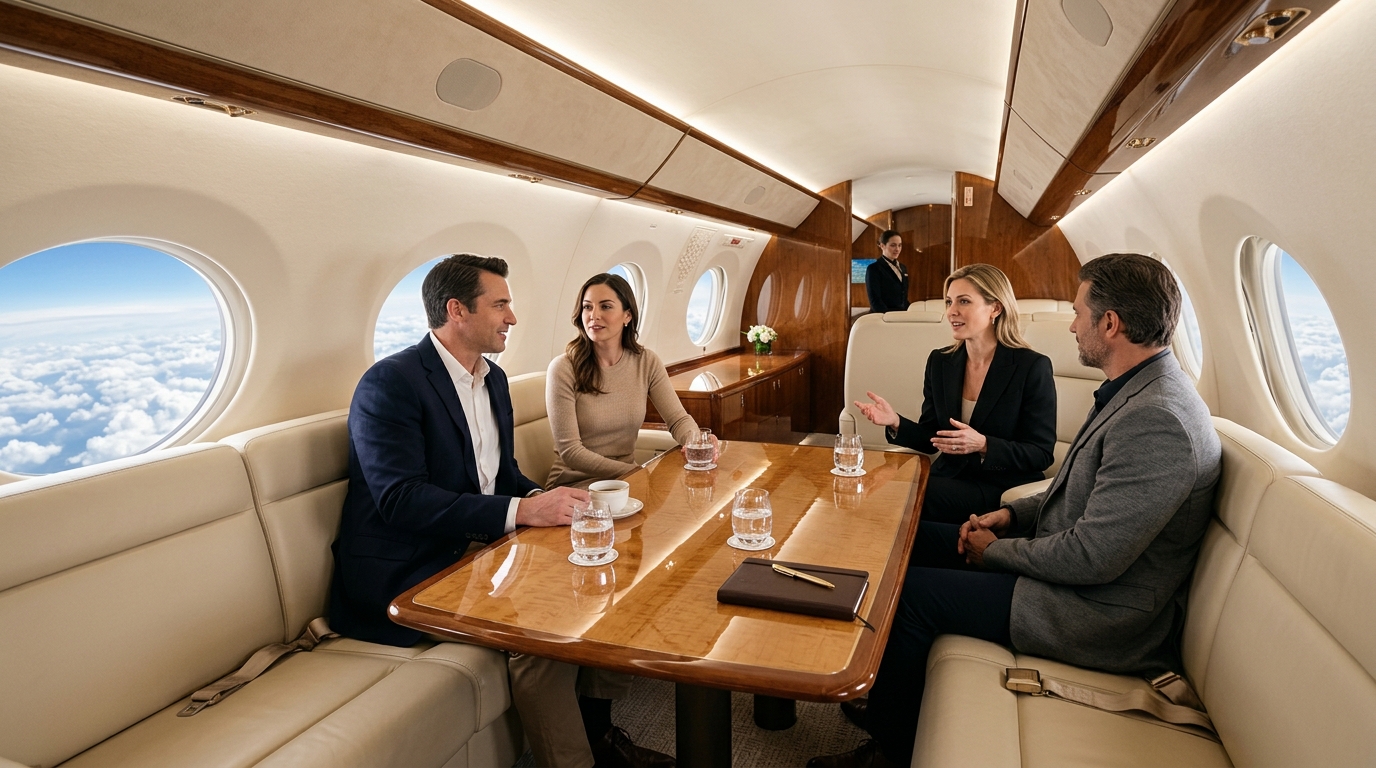
The Gulfstream G700's cabin measures 6 ft 3 in in height and 8 ft 2 in in width, edging out the Global 7500's 6 ft 2 in height at the same 8 ft 2 in width, a difference of one inch that is genuinely noticeable when a 6 ft 4 in passenger stands up after nine hours in a seat. Gulfstream also fits its 100-square-inch oval windows, the largest in business aviation, into a cabin stretching 56 ft 11 in, split into as many as five discrete living areas.
The Bombardier Global 7500 answers with four defined zones across a 54 ft 5 in main cabin, including a permanent, dedicated crew rest suite with a proper bed rather than a divan, and a principal suite at the rear with its own bed and en-suite shower option. That distinction matters specifically past the eight-hour mark: two rotating crew members getting genuine rest on a 13-hour sector arrive able to handle an early-morning arrival slot properly, and a client sleeping in an actual bed rather than a reclined seat lands closer to functional than jet-lagged.
Cabin altitude is where both manufacturers make their loudest claims, and the numbers are close enough to be a rounding error in practice: the G700 holds cabin altitude to roughly 2,916 ft at a cruise altitude of 41,000 ft, while the Global 7500 sits close behind at around 2,993 ft. Neither figure changes how a client feels on an 11-hour flight in any way they would notice without being told the numbers first.
Where the cabins genuinely diverge is flexibility of configuration rather than raw dimensions. The G700's fifth zone can be built out as a proper crew rest area, a private stateroom, or additional seating depending on how the operator specced the aircraft, while the Global 7500's four zones are more fixed in their intended use, trading configurability for the certainty that the crew rest suite and principal suite will always be there.
Which Aircraft to Charter, and When It's Worth Paying the Difference
Book the Gulfstream G700 over the Global 7500 when the sector runs under nine hours block time, the group is six passengers or fewer, and the mission genuinely benefits from the extra 20 to 30 minutes Mach 0.935 saves over a 5,000-nautical-mile leg. At that profile, the £1,000 to £1,500 hourly premium adds roughly £6,000 to £12,000 to the total charter cost, a figure worth paying for a same-day boardroom-to-departure-lounge turnaround where the time saved has a real value attached to it.
Above nine hours block time, or with more than eight passengers who need a genuine fourth zone rather than a shared cabin, the Bombardier Global 7500 is the harder aircraft to justify overpaying past. Its dedicated crew rest suite keeps a two-pilot rotation properly rested on sectors like Hong Kong to New York, its principal suite gives one passenger an actual bed rather than a converted divan, and its lower hourly rate means the total charter cost for a 13-hour sector can run £15,000 to £25,000 below an equivalent G700 quote.
The Gulfstream G700 vs Global 7500 charter rates decision ultimately comes down to whether the mission is buying speed or buying space. Six or fewer passengers on a same-day sector under nine hours favours the G700's cruise performance and marginally larger cabin cross-section. Eight or more passengers, an overnight sector past eleven hours, or a requirement for a genuine crew rest suite favours the Global 7500 on both comfort and cost.
Villiers quotes both aircraft type by type against the specific mission rather than by brand preference, because the rate gap between them is real money on every sector length, and the aircraft that wins the comparison changes with the route, the passenger count, and how many hours the crew will actually be awake at the other end.