 Farnborough
 Nice
Nice
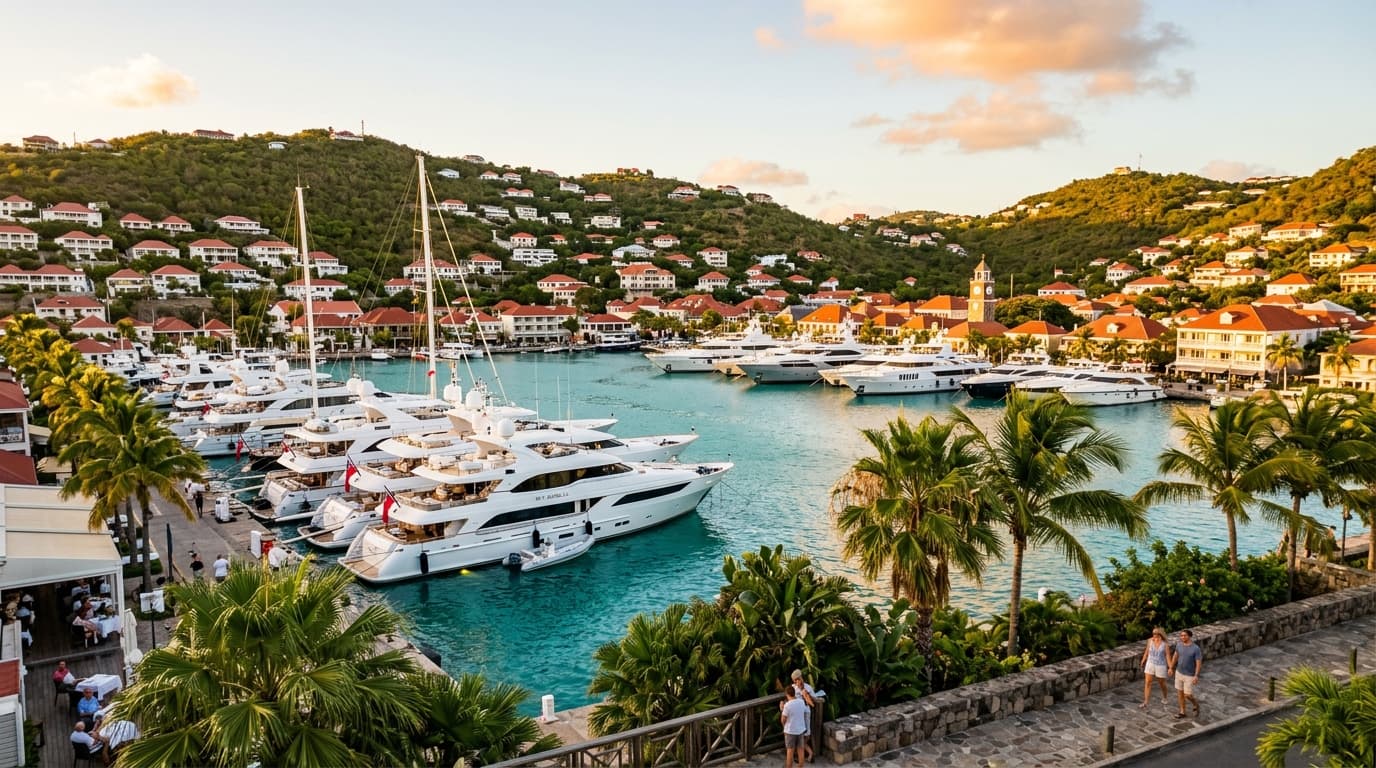
Why St Barths Is a Gateway Problem, Not a Runway Problem
Gustaf III airport (TFFJ) has a runway of roughly 650 metres, a steep approach over a hilltop road and a daylight-only operating window, which is why almost no jet has ever been cleared to use it. The aircraft that do land there are small turboprops, typically the Twin Otter, the Pilatus PC-12 and the Cessna Caravan, carrying between six and nineteen passengers.
That shapes the whole journey. Anyone searching for a private jet to St Barts is really asking two questions: which larger airport will take the jet, and how quickly can a small aircraft, helicopter or boat cover the remaining distance? The answer to the second question decides which gateway makes sense.
Three airports serve the island realistically. Princess Juliana on Sint Maarten (TNCM) is the closest major runway, about 25 km away. Anguilla's Clayton J. Lloyd airport (TQPF) is a quieter alternative roughly 35 km to the north-west. Antigua's V.C. Bird (TAPA) is the long-runway fallback some 200 km to the south-east, useful when the others are full.
Each one trades something against the others: transfer time, parking, customs handling or runway length. Weighing those trade-offs is the actual work of planning the trip, and it is far more important than the choice of aircraft.
Saint Martin, Anguilla or Antigua: Choosing the Right Gateway Airport
Princess Juliana is the default for good reason. Its 2,300 metre runway takes everything up to a Gulfstream G650ER or Bombardier Global 7500, and a turboprop or helicopter reaches Gustaf III in about 10 to 15 minutes. The drawback is congestion. Ramp space is finite, and in the weeks around Christmas the apron fills with large-cabin jets that have nowhere to park.
Anguilla suits smaller groups who value calm over speed. Its runway of around 1,500 metres handles midsize jets such as the Challenger 350, and the terminal rarely queues. The onward link is less direct: a boat from Blowing Point to Marigot takes about 25 minutes, followed by a ferry from Marigot to Gustavia of 45 to 60 minutes depending on sea state. Allow three hours door to door from the aircraft steps, or book a helicopter and cut that to roughly 20 minutes.
Antigua is the pragmatic choice when parking is the issue. V.C. Bird has a 3,000 metre runway, generous ramp capacity and handlers used to heavy winter traffic. The cost is distance. A private turboprop covers the 200 km hop to Gustaf III in around 45 minutes, so the total transfer is longer than from Sint Maarten, but it is dependable.
A simple rule works well. Parties of up to eight who want the quickest arrival should aim for Sint Maarten and book the transfer before the jet. Groups travelling with a larger aircraft in the Christmas peak, or those who need to leave the jet on the ground for a week, should treat Antigua as the primary option rather than a backup.
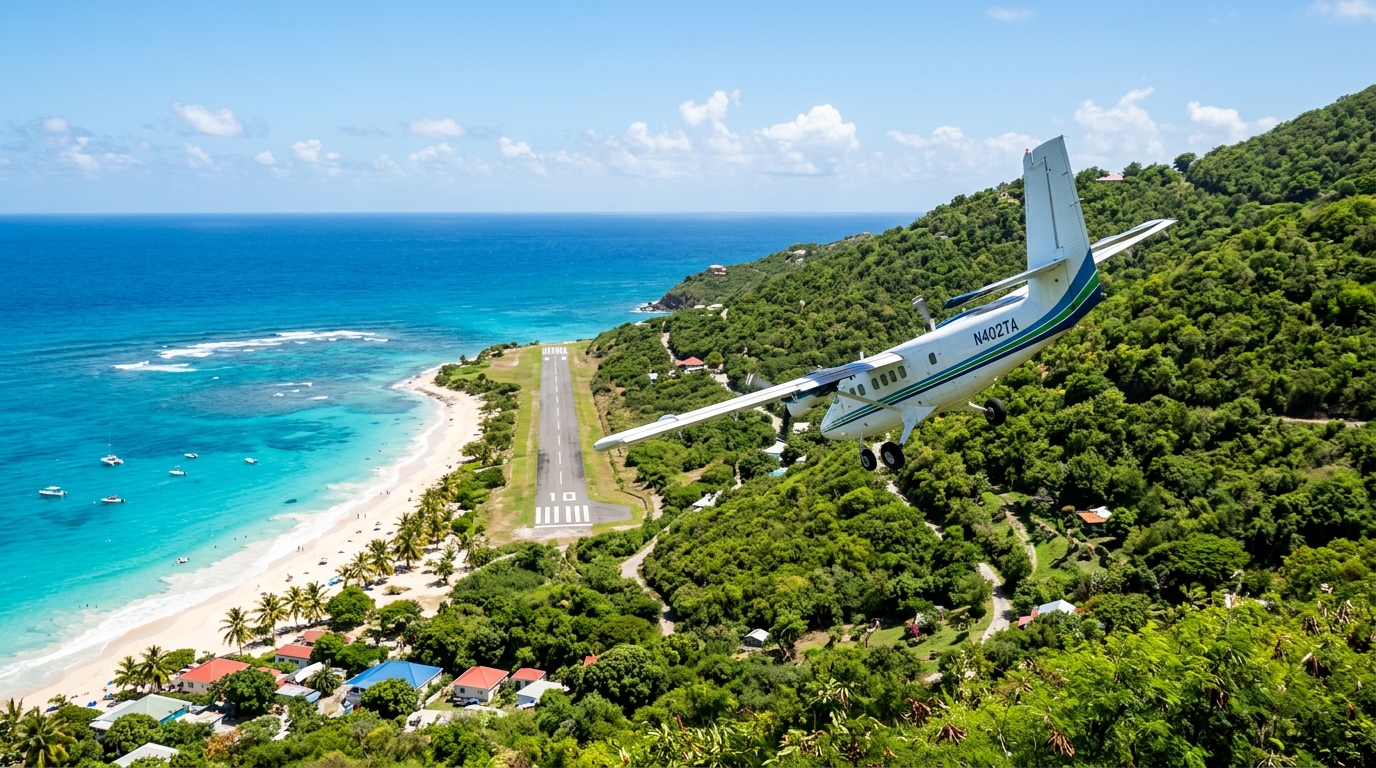
The Last Leg: Turboprop, Helicopter and Sea Transfers to Gustaf III and Gustavia
The final 25 km is where trips are won or lost. Operators run scheduled turboprop shuttles from Sint Maarten and San Juan, and private charters of a Twin Otter or PC-12 are available on request, usually for a few thousand euros per sector depending on the aircraft and the day. A turboprop carries luggage easily, which matters when a family arrives with golf bags, kitesurf kit and a nanny.
Helicopters are the second option. They cannot land at Gustaf III during every operating window, but they can use approved helipads on the island and are valued for flexibility. A flight from Princess Juliana to St Barths lasts about 10 minutes. Prices are typically a few thousand euros per leg for a private charter, and they rise sharply in the last two weeks of December.
By sea, the Voyager ferry and private yachts run from Marigot, Oyster Pond and Philipsburg to Gustavia. The crossing takes 45 to 75 minutes. Swell can make it rough on the open channel, so travellers prone to seasickness should not plan on a boat leg after a long transatlantic flight.
Timing matters more than the mode. Gustaf III closes at sunset, which in December is around 17:30 local time, and the last scheduled departure is often earlier. A jet landing at Princess Juliana after 16:00 risks missing the final turboprop, so build in an hour of slack or arrange a sea transfer as a safety net.
Baggage is the other quiet constraint. Turboprops operate to strict weight limits, and soft bags travel more easily than hard cases. Tell your broker the exact baggage count before the transfer is arranged, not at the airport.
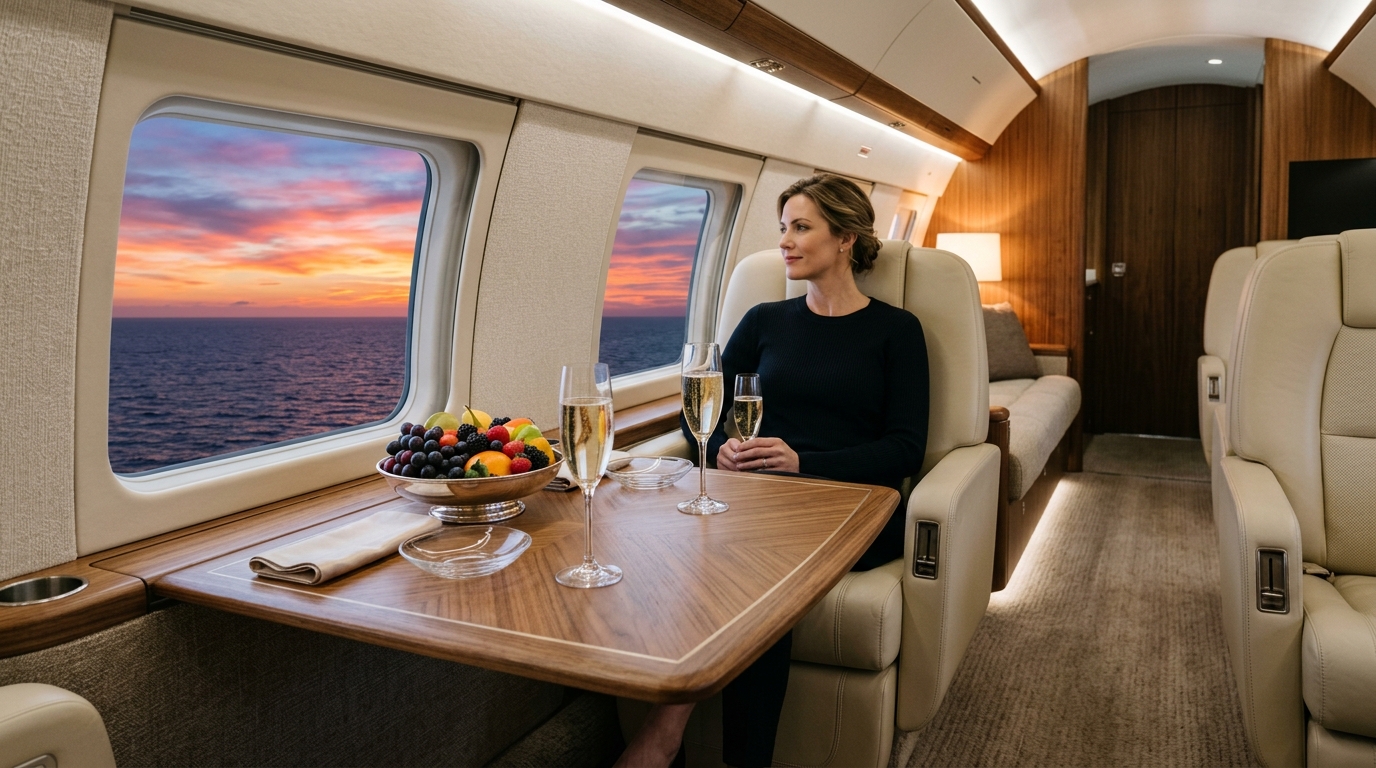
Which Aircraft Fly London or Europe to the Caribbean (and Where They Need to Stop)
The distance from London to Sint Maarten is roughly 3,700 nautical miles, and that single figure divides the fleet cleanly. Anything with a range under about 4,000 nm needs a fuel stop; anything above can fly nonstop.
The Challenger 350 has a range of around 3,200 nm and a cabin width of 7 ft 2 in. It can carry up to eight passengers in comfort, but it cannot cross the Atlantic nonstop. The usual stop is Lajes in the Azores (LPLA) or Santa Maria, adding roughly 90 minutes. The Citation Longitude, at 3,500 nm range and a 6 ft 3 in cabin height, runs the same pattern.
The nonstop options are the ultra-long-range jets. The Dassault Falcon 8X flies 6,450 nm and offers a 7 ft 8 in cabin width, seating up to 12 on a typical layout. The Gulfstream G650ER reaches 7,500 nm with an 8 ft 2 in cabin width. The Bombardier Global 7500 flies 7,700 nm, and the Gulfstream G700 and Dassault Falcon 10X are its direct competitors at the top of the market. A nonstop sector from London Farnborough (EGLF) or Biggin Hill (EGKB) takes about 8 hours 30 minutes.
Pricing follows the aircraft. A London to Sint Maarten sector on a Challenger 350 with a fuel stop typically runs from £75,000 to £100,000 one-way. A nonstop flight on a Falcon 8X, G650ER or Global 7500 sits at about £95,000 to £140,000 one-way, with Christmas week at the top of that range. Positioning legs are charged separately when the aircraft is not returning.
For groups of up to eight, the Challenger 350 and its stop is the economic route. Above eight passengers, or for anyone who values arriving rested, the nonstop large-cabin jets are the sensible choice. From the US East Coast the picture is simpler: a Citation Latitude or Challenger 350 reaches Sint Maarten from Teterboro (KTEB) in about 4 hours 15 minutes without stopping.
Booking Christmas, New Year and the Winter Season: Timing, Parking and Customs
The peak window runs from roughly 20 December to 5 January, and parking at Princess Juliana is the first resource to disappear. Large jets are often asked to drop passengers and reposition to Antigua or San Juan, which means the crew flies an extra sector that you pay for. Book 10 to 12 weeks ahead for the peak and confirm parking permission in writing before the deposit is paid.
Turboprop and helicopter seats on the final leg go earlier still. Charter operators on Sint Maarten often hold their best slots for returning clients from September, so a first-time traveller should reserve the onward link at the same moment as the jet. Where the jet is confirmed and the transfer is not, the trip has not really been booked.
New Year's Eve is the tightest single date. Everyone wants to arrive on 28 to 30 December and depart on 2 to 3 January, so shifting by one day either side often releases ramp space at a lower price. Empty-leg opportunities also open up on the shoulder dates, and a flexible broker will find them if you allow a 48-hour window.
Customs and immigration differ by gateway. Sint Maarten and Anguilla each require passport checks and advance notification of the passenger manifest. Arrivals on St Barths involve a further French-territory check, so passports must be valid for the full stay, and a general declaration should be filed with the handler 24 hours before departure. A good broker will have the paperwork, the handler and the crew's landing permissions in place well before the flight leaves Europe.
For the rest of the winter, the picture eases markedly. From mid-January to March, parking is easier, rates fall by 15 to 25 per cent compared with Christmas week, and the same routing works with far less planning. If the dates are fixed, book the gateway first and the aircraft second; if the aircraft is fixed, let the gateway follow.
Either way, the shortest route to the island is never the one with the biggest aircraft, but the one with a confirmed parking slot, a confirmed onward seat and a plan for the final daylight hour.