Why Cheltenham Festival Is a Private Aviation Challenge, Not a Commercial One
Gloucestershire Airport at Staverton (EGBJ) sits roughly 15 minutes by road from Prestbury Park, yet its apron holds only a few dozen aircraft, and Festival week asks it to absorb far more than that. Cheltenham has no major airport on its doorstep, so every arrival is a choice between small airfields that were never built as racing gateways.
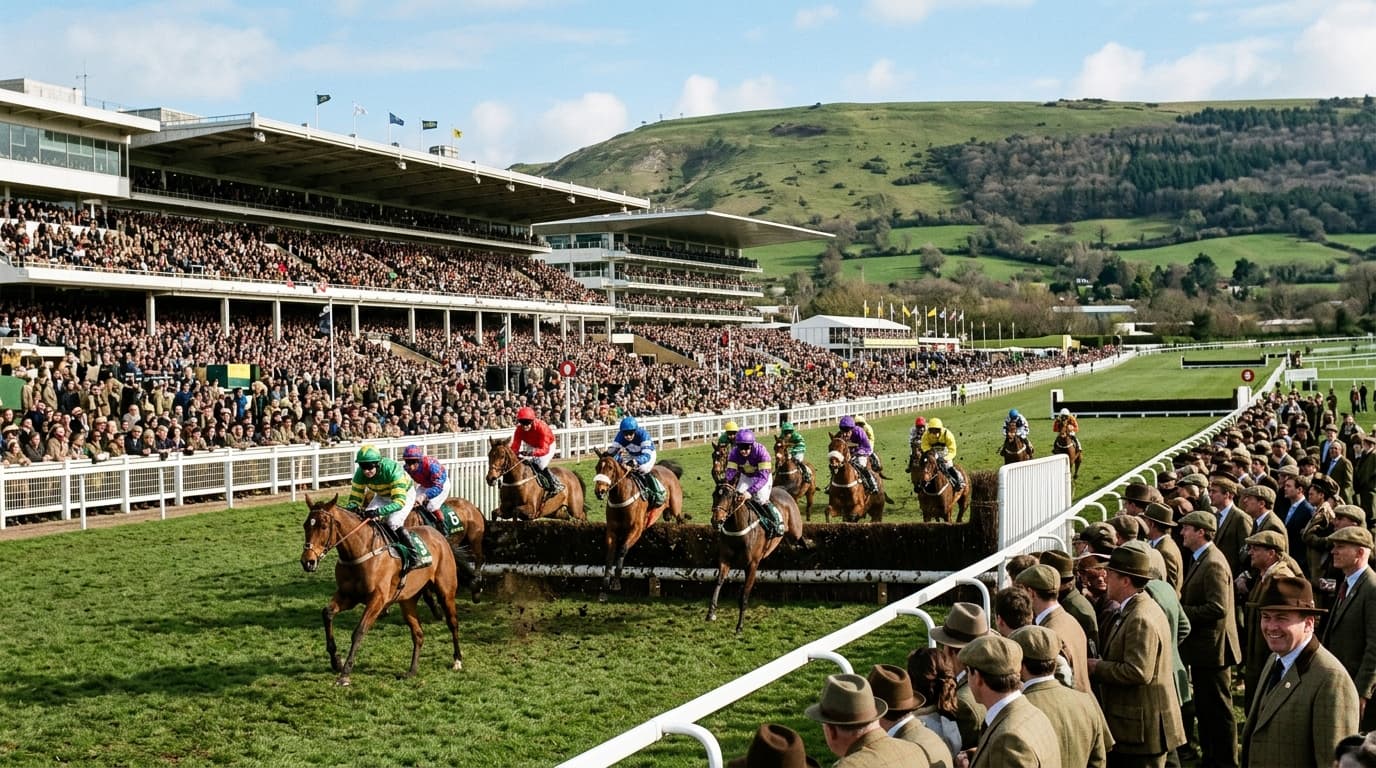
The Festival runs from Tuesday 16 to Friday 19 March 2027, and the biggest days draw around 70,000 racegoers to the course. The nearest large airports, Bristol and Birmingham, are each more than an hour away by road in normal traffic. That leaves the smaller fields: Staverton, Cotswold Airport at Kemble (EGBP) and Oxford Kidlington (EGTK), plus the two larger airports as fallbacks.
That is why any Cheltenham Festival private jet plan should start with the airfield rather than the aircraft. The airfield sets your road transfer, your customs options and the largest jet you can realistically bring.
Corporate hosts and owners tend to plan backwards from the racing. A hospitality lunch begins around 12:00, the first race is usually mid-afternoon, and an owner with a runner needs to be at the parade ring well before the saddling bell. Landing by 11:00 gives a party time to reach the course, settle in and avoid the worst of the arrival queue.
Price shapes the decision too. A Farnborough (EGLF) to Staverton or Kemble sector on a Phenom 300E typically runs £4,000 to £6,500 one-way in Festival week, depending on lead time and positioning. Midsize jets on the same sector sit nearer £6,500 to £9,500.
Gloucestershire Airport, Kemble, Oxford, Bristol or Birmingham: Choosing Your Arrival Airport
The five airfields differ far more on road time than on flight time, and road time is what you will feel on the day. Here is how each performs.
Gloucestershire Airport, Staverton (EGBJ). This is the closest option, at about 15 to 20 minutes from the course on a normal day and 30 to 45 minutes when race-day traffic builds on the A40 and around Cheltenham. Its main runway is roughly 1,400 metres, which suits light and some midsize jets. Customs is available only by prior arrangement, so international arrivals need that confirmed in writing well ahead.
Cotswold Airport, Kemble (EGBP). Kemble is about 25 miles from the course, a drive of 40 to 50 minutes. Its runway of roughly 1,980 metres is the longest of the three small fields and removes most weight restrictions for midsize jets. Parking is generous compared with Staverton, though the Festival still fills it, and customs also needs prior notice.
Oxford Kidlington (EGTK). Oxford is around 45 miles away, a transfer of 70 to 90 minutes in Festival traffic. Its strengths are a well-run business aviation operation and routine customs handling, which matters for guests arriving from Ireland, France or further afield. The runway of roughly 1,200 metres limits larger types.
Bristol (EGGD). Bristol has a runway of about 2,000 metres, full customs and plentiful ground handling. The drive is roughly 50 miles, typically 70 to 80 minutes, and the M5 corridor is where Festival traffic compresses.
Birmingham (EGBB). Birmingham offers a 3,000-metre runway and the full range of handling, so it takes any aircraft up to a large-cabin jet. The road transfer of about 55 miles takes 75 to 90 minutes, which makes it the right answer only when the aircraft or the customs requirement dictates it.
A practical filter: if your party can accept a transfer of under 50 minutes, the decision is between Staverton and Kemble. If the aircraft needs more than 1,400 metres of runway, or the party is clearing customs on arrival, Kemble, Bristol and Birmingham come forward, with Oxford the alternative where a shorter runway is acceptable.
Which Aircraft Suit Cheltenham's Smaller Airfields
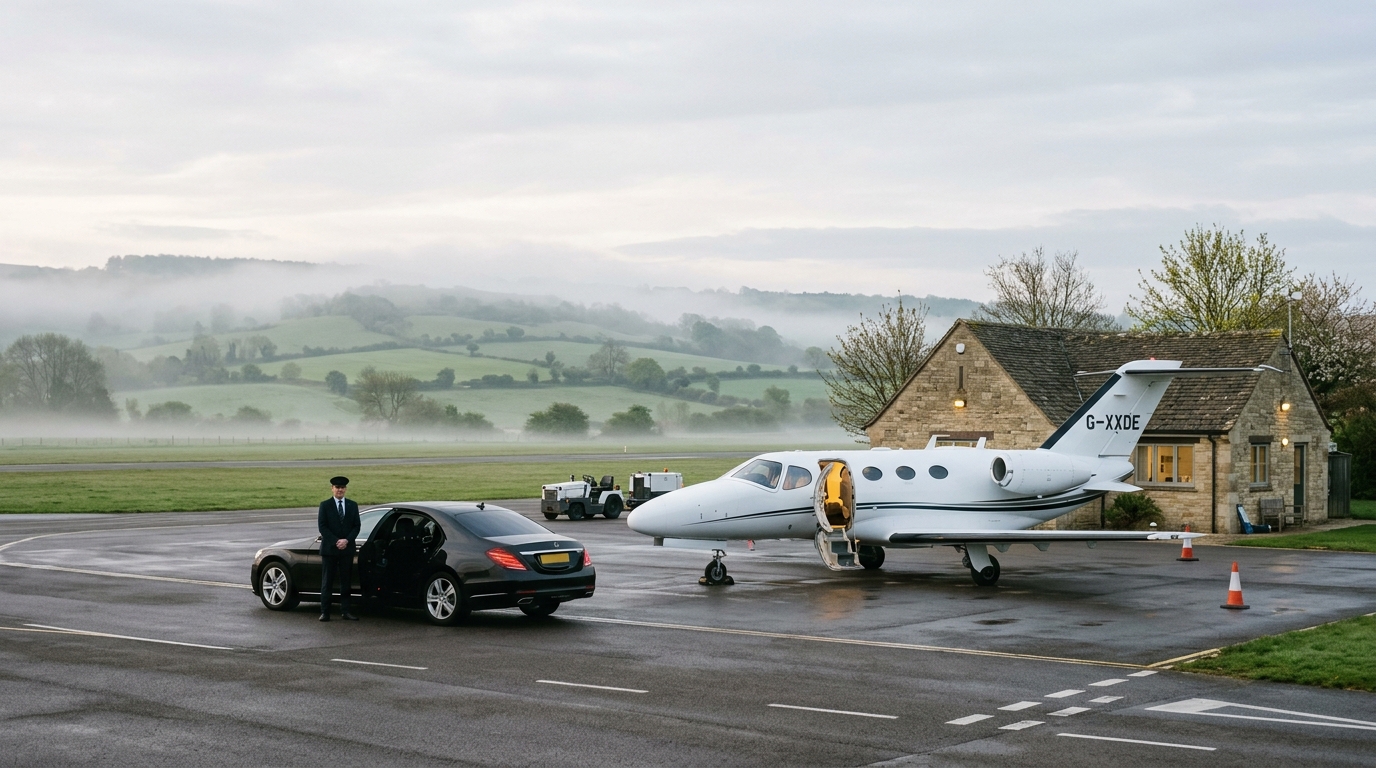
Runway length and apron space, not cabin comfort, decide which jets can operate. The Embraer Phenom 300E is the natural fit: its takeoff field length at maximum weight is around 3,200 feet at sea level, comfortably inside Staverton's runway. It seats six to eight, and its cabin measures 5 ft 1 in wide by 4 ft 11 in high.
For parties of six to eight who want more room, the Cessna Citation XLS+ offers a 5 ft 6 in wide and 5 ft 6 in high cabin, with a standing-height aisle that makes a difference on a morning positioning leg from London or Dublin. It operates readily from Kemble and, with sensible fuel planning, from Staverton.
Groups of nine or ten should look at the Bombardier Challenger 350, whose cabin is 7 ft 2 in wide and 6 ft high. Its takeoff requirement of roughly 4,800 feet means a full load on a warm day pushes against Staverton's limits, so Kemble or Bristol is the safer base for that aircraft.
The lighter Citation CJ4 suits smaller parties of four to six. Its cabin is narrower than the Phenom 300E's, so it rewards short hops rather than long days on board.
Whichever aircraft you choose, check three things with your broker before confirming: the maximum takeoff weight the operator will accept at that field, the parking footprint for the aircraft's wingspan, and whether the crew's duty hours cover a Gold Cup day that may end with a late departure.

Gold Cup Day Logistics: Ground Transfers, Helicopter Links and Timing Your Departure
The Cheltenham Gold Cup falls on Friday 19 March 2027, and it is the day when the road network is least forgiving. Racegoers arrive in a concentrated wave before the first race, and the exit queue after the Gold Cup can add 45 minutes or more to a drive that takes 20 minutes on an ordinary afternoon.
A dedicated chauffeur-driven car, met at the aircraft steps, is the baseline for most parties. Ask your driver to use the course's designated drop-off points for hospitality guests rather than the general approach roads, and agree a pickup point before the day starts.
Helicopters change the equation for guests who would rather not drive at all. A transfer from Kemble to the course takes about 12 minutes in the air, and from Oxford around 20 minutes. Landing at the course requires prior permission and a slot arranged through the racecourse, and it is a limited facility, so it is worth requesting early. A helicopter connection from a larger airport such as Birmingham is feasible for a party that must use a long runway, though the cost rises accordingly.
Departure timing is where most Festival plans go wrong. The Gold Cup itself runs in the mid to late afternoon, and the card finishes around 17:30. Leaving the course at the end of racing and driving back to an airfield means a wheels-up time no earlier than 19:30 for Staverton, and later for Oxford or Birmingham.
Two things protect your evening. First, build in a buffer: tell the crew the party will be at the aircraft 30 minutes before the planned departure, not at departure. Second, check the airfield's operating hours and any noise or curfew restrictions, because several of the smaller fields close or restrict movements in the evening. A late finish at Kemble or Staverton without prior approval can leave you stranded for the night.
Some parties avoid the problem by flying out the following morning, staying overnight in the Cotswolds. That works well for owners with runners on the final day, who often prefer a relaxed departure to a rush.
When to Book: Parking Slots, Festival Week Demand and Planning Five Months Out
Booking in October for a March Festival feels early, and it is exactly when parking slots at the small airfields start disappearing. Staverton and Kemble have limited apron space, and operators who hold slots for their own clients tend to release them only a few weeks before the event.
Five months out gives a broker time to secure three things in sequence: the airfield slot, the aircraft and crew, and the ground transfers or helicopter slot. Leaving it to February often means the right aircraft is available but the right airfield is not, forcing a longer road transfer or a switch to a larger jet that needs a longer runway.
Pricing follows demand. Festival week charter rates for a Phenom 300E from London typically rise by 15 to 25 per cent compared with a standard March week, and midsize jets such as the Challenger 350 sit at the upper end of that range. A one-way flight from Farnborough on a Challenger 350 commonly lands between £7,000 and £10,000, depending on positioning legs.
If you are hosting clients, decide your decision threshold early. A party of four or more, or any group needing a guaranteed arrival before 11:00 on race day, is the point at which a private charter stops being a convenience and becomes the only way to control the timetable. For a group of that size, locking in the aircraft and airfield by the end of October is the safest approach.
Share the racing diary with your broker as soon as it exists: which days, which hospitality marquee, whether an owner's runner is involved, and the latest acceptable departure time. With those details in hand, a Festival plan can be built around the racing instead of around the aircraft, which is the way it should always be done.