 Farnborough
 Nice

Why Masters Week Is One of the Hardest Weeks of the Year to Land a Private Jet
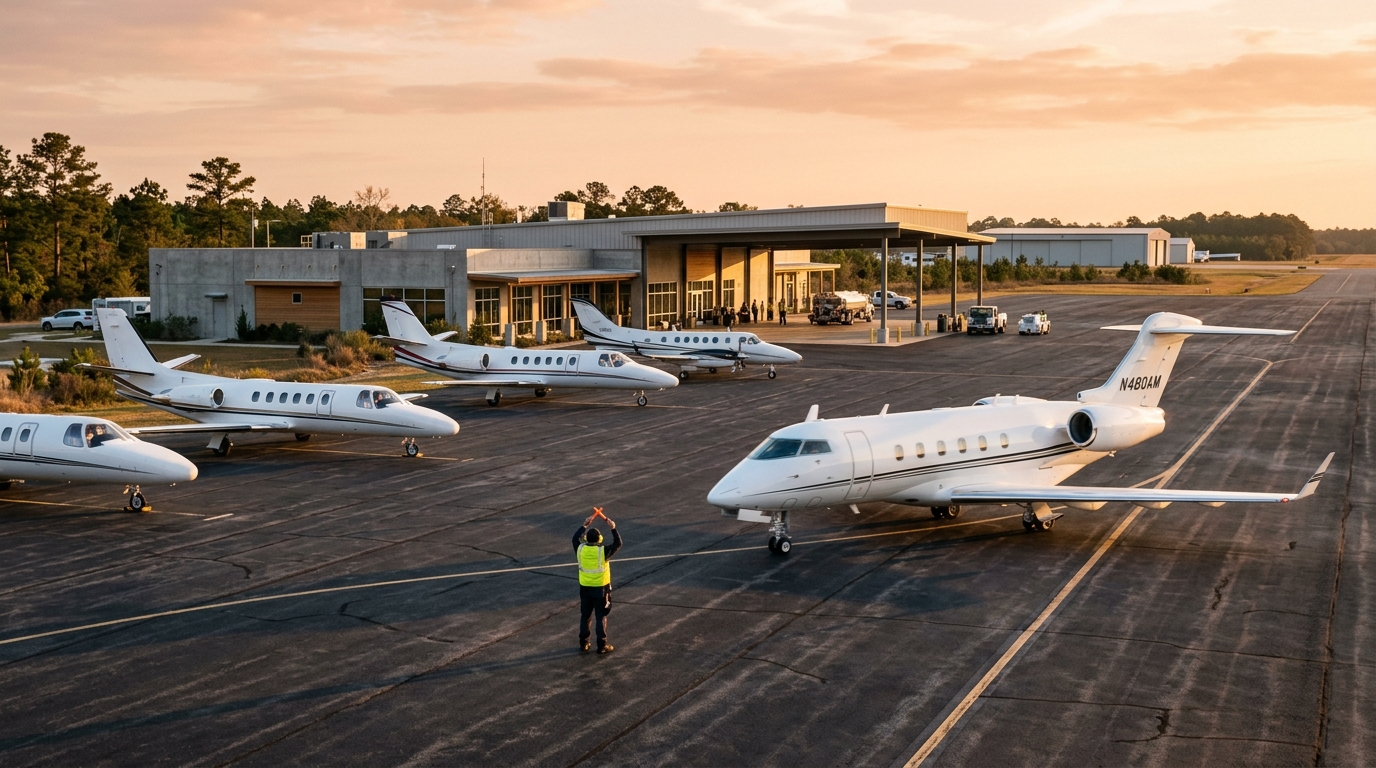
Augusta Regional (AGS) has a general aviation apron sized for an ordinary week, yet Masters week pushes a surge of private arrivals through it that local handlers routinely describe as several hundred movements in under five days. The airport's main runway is typically around 8,000 ft, so length is not the problem. Space, staffing and timing are.
The tournament is expected to run from Thursday 8 April to Sunday 11 April 2027, with practice rounds from Monday 5 April; confirm the dates against the club's published calendar. Demand is not spread evenly across those days. Arrivals bunch on Tuesday and Wednesday, and departures bunch on Sunday evening once the green jacket has been presented.
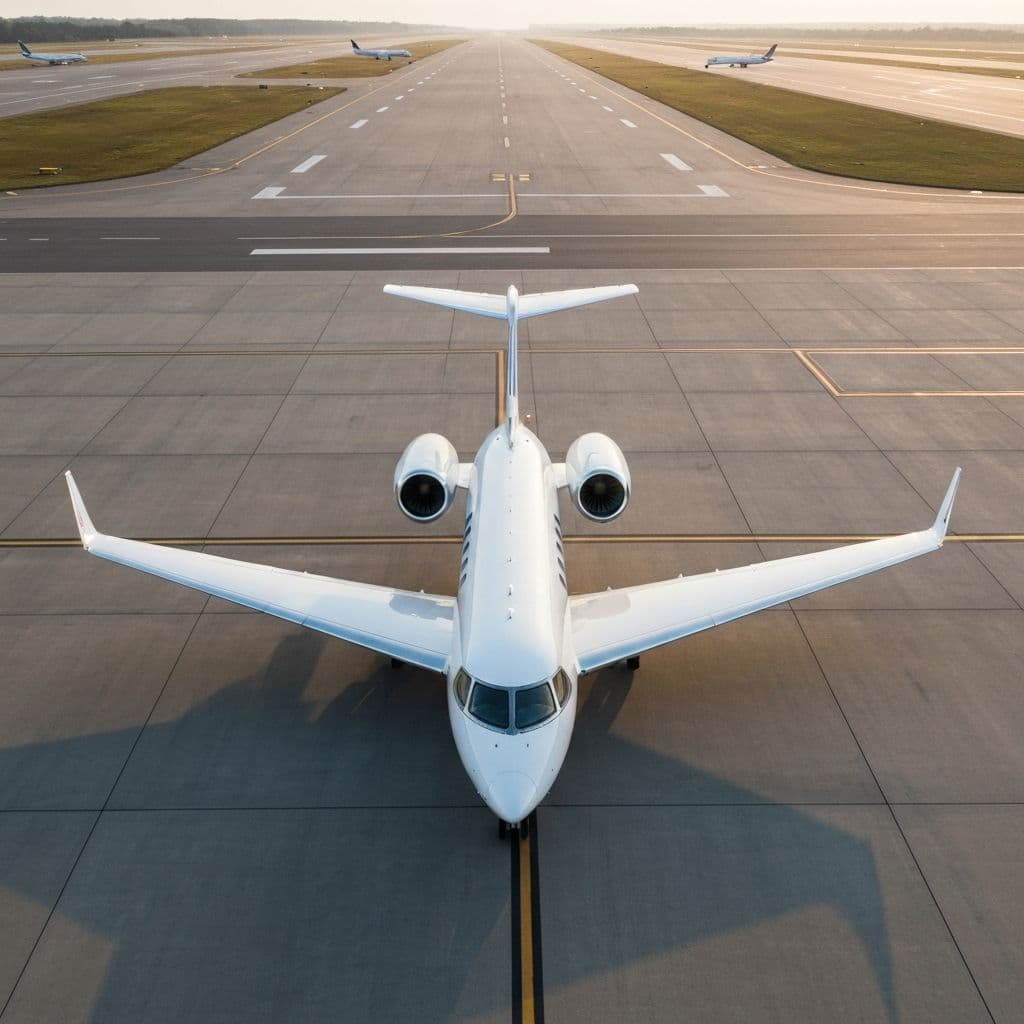
Three separate constraints bite at once. The first is physical apron space: a Bombardier Global 7500 is about 111 ft long with a wingspan of roughly 104 ft, so one of them occupies the room two light jets would. The second is handling capacity, meaning fuel trucks, ramp crews and the FBO's ability to marshal aircraft onto stands. The third is airport notices, which typically bring prior permission requirements and limits on how long an aircraft may remain.
For a UK party this matters more than it does for a flight from Florida or Texas. The transatlantic leg needs a large-cabin aircraft, and the biggest airframes are the ones the ramp is least able to hold. Anyone planning a Masters 2027 private jet trip should treat the parking question as the first decision, not something to sort out once the aircraft has been chosen.
Augusta Regional (AGS) vs Aiken, Columbia and Atlanta: Which Airport to Choose
The closest runway is not always the one that gets you to the first tee on time. Four airports are realistic, and each trades road time against ramp pressure.
Augusta Regional (AGS). The default choice, with a drive to the club of about 20 to 30 minutes in tournament traffic. Its runway, typically around 8,000 ft, is long enough for a Gulfstream G650ER or Global 7500 arriving nonstop from London. The cost is that AGS is where everyone else is trying to park too, so it demands the earliest and firmest handling confirmation. Check also that US customs clearance is available at your arrival hour, because an international arrival cannot simply land anywhere.
Aiken (KAIK). A quiet field with a drive of roughly 35 to 45 minutes to the club. Its runway is typically around 5,500 ft, which suits an Embraer Phenom 300E or Citation CJ4 but not a large-cabin transatlantic jet. It works as the destination for a short hop from a customs-entry airport, not as a nonstop arrival from Farnborough.
Columbia (CAE). About 75 to 90 minutes by road, with a runway typically beyond 8,000 ft and, in our experience, more apron room than AGS in the same week. For a party of six or more with a large aircraft, it is the strongest alternative when AGS cannot confirm parking. The longer transfer is the price of certainty.
Atlanta (KATL or KPDK). Roughly 2 hours 15 minutes to 2 hours 45 minutes by road, which is why it only makes sense with an onward flight. Clearing US customs in Atlanta, then taking a Phenom 300E of about 30 minutes to AGS or Aiken, is a standard fallback when customs or parking at Augusta is the sticking point.
For a nonstop large-cabin arrival from London, that leaves AGS and Columbia as the only two options, because both offer runways typically above 7,500 ft; Aiken falls below that figure. Confirm current runway lengths and customs hours in the airport notices before committing.
London to Georgia: Aircraft Choice and Flight Times for the Transatlantic Leg
Farnborough (EGLF) to Augusta is a sector of about 3,700 nm, and that distance decides the aircraft before budget does. Westbound headwinds typically produce a block time of 8 hours 15 minutes to 8 hours 45 minutes, so an 08:00 departure from EGLF lands around 11:30 local time, with Georgia five hours behind the UK in April. The return, helped by the jet stream, usually takes 7 hours 15 minutes to 7 hours 45 minutes.
Three aircraft cover the leg nonstop with a full cabin:
- Gulfstream G650ER: 7,500 nm range, a cabin 8 ft 2 in wide and 6 ft 3 in high, and seating for up to 19, though charter layouts usually carry 13 to 16. It is the natural choice for a group of ten or more.
- Bombardier Global 7500: 7,700 nm range, a cabin 8 ft 6 in wide and 6 ft 2 in high, and a separate bedroom suite in some layouts. Four defined cabin zones suit a party that wants to work and rest on an eight-hour sector.
- Dassault Falcon 8X: 6,450 nm range, a cabin 7 ft 8 in wide and 6 ft 2 in high, and a three-engine layout. It suits six to ten passengers and often lands at a lower price than the two larger jets.
A Challenger 350, with a range of about 3,200 nm, cannot make Georgia nonstop from London. It needs a fuel stop, which adds roughly 60 to 90 minutes, and for a Masters week where arrival windows are tight, that extra stop is a risk rather than a saving.
As a pricing guide, a one-way charter on a G650ER, Global 7500 or Falcon 8X from Farnborough or Luton to Augusta in Masters week typically runs to £80,000 to £115,000. That is the author's estimate, built from per-flight-hour rates of roughly £9,000 to £12,000 across about 8.5 hours, plus a peak-week premium. A return trip, where the aircraft leaves after drop-off and comes back for you, runs to £160,000 to £230,000 in total, before any parking or repositioning charges.
The onward-hop option is far cheaper. A Phenom 300E, with a 5 ft wide by 4 ft 11 in high cabin and room for up to six comfortably, typically costs £3,500 to £5,500 one-way for the Atlanta to Augusta leg, again as an estimate that varies with lead time.
Parking, Ramp Space and Slot Timing: How to Avoid Being Turned Away
A confirmed charter price means nothing without a confirmed place to put the aircraft. Ask the FBO for written parking confirmation covering your arrival window, the length of stay and your departure window; a verbal assurance is not enough in this week.
The central choice is between staying and dropping. A stay-over aircraft sits on the ramp for the duration, which takes the most space and attracts the tightest conditions. A drop-and-go aircraft unloads, then repositions to Columbia or Atlanta to park, and returns for the pick-up. Augusta to Columbia is about 65 nm, a flight of roughly 25 minutes, so the repositioning leg is short; the cost is two extra sectors and the need to coordinate a return slot.
Timing within the day matters as much as the day itself. Mid-morning to early afternoon on Tuesday and Wednesday is typically the heaviest arrival period, so ask the FBO which windows it can actually honour. An arrival on Monday or early on Tuesday, or on Friday for a weekend visit, sits outside the main surge and is more likely to be confirmed.
Departures are harder. Sunday evening, once the final group has finished, is when every aircraft wants to leave at once. A Monday-morning departure removes most of that queue, and a party that can stay one extra night will find ramp staff far more flexible. If Sunday evening is non-negotiable, ask for a departure window of 30 minutes in writing, and have the crew file early.
Two checks avoid the most common refusals. First, confirm the aircraft's wingspan and length against the stand it will be given, because the largest jets are sometimes redirected to a different part of the apron. Second, make sure the handler has the crew's details and the aircraft registration well before arrival, as late changes of tail number are a frequent reason for a delayed clearance.
When to Book, What It Costs and How to Build in a Fallback
With practice rounds starting on 5 April 2027, and today being 12 November 2026, there are about 21 weeks to work with. Aim to have the aircraft and a written parking confirmation in place by the end of December 2026, around 13 weeks before the first practice day. The final ceiling is the end of January 2027, about nine weeks out; after that the choice of large-cabin aircraft and apron space narrows sharply.
Budget for three cost lines. The charter itself, at £80,000 to £115,000 each way on the large-cabin jets named above. Handling and overnight parking, which are priced for peak demand and should be quoted in advance. And, if you drop and reposition, the extra sectors to Columbia or Atlanta, which add the price of two short flights.
The fallback should be agreed before departure, not decided in the air. Set it out in three tiers: AGS as the primary plan; Columbia with a road transfer of 75 to 90 minutes if AGS cannot confirm; and a customs-entry stop at Atlanta with a Phenom 300E or Citation CJ4 hop of about 30 minutes if neither suits. Share all three with the crew so the flight plan can switch without a fresh clearance request.
The working method is simple. Fix your party size and choose a G650ER, Global 7500 or Falcon 8X to match; obtain written parking and customs confirmation for AGS; decide now whether you are staying or dropping; and agree your Columbia and Atlanta fallbacks in writing by the end of December.