
Why Bethpage Black Puts Unusual Pressure on New York's Private Jet Airports
Republic Airport's single runway measures 6,743 feet, too short for a fully fuelled Bombardier Global 7500 or Gulfstream G650ER to land safely, which is exactly why the airport closest to Bethpage Black cannot absorb the aircraft that just crossed the Atlantic to reach it. That single fact shapes almost every decision a broker makes when planning a ryder cup private jet itinerary for the 2026 tournament at Bethpage Black, held from 25 to 27 September.
New York's three main general aviation airports, Teterboro (KTEB), Westchester County (KHPN) and Republic (KFRG), normally divide business aviation traffic across northern New Jersey, lower Westchester and central Long Island without much overlap. A Ryder Cup week compresses that traffic into a single fortnight, with practice rounds from the Tuesday before and the closing ceremony on the Sunday pulling in arrivals from across Europe, the Gulf and South America simultaneously.
Long Island itself adds a further complication that a typical Manhattan-bound charter never faces. Bethpage State Park sits roughly 30 miles east of Manhattan on a corridor served by exactly two arterial roads, the Long Island Expressway and the Southern State Parkway, both of which the New York Police Department partially closes for tournament traffic management during the event.
For clients booking travel to Bethpage this September, that mismatch between proximity and runway length, combined with a road network that chokes under normal conditions, is the single most important fact to plan around. Every hour saved on the ground needs to be built into the flight plan before departure, not solved after landing.
Teterboro vs Westchester vs Republic: Which FBO Actually Gets You to the Course Fastest
Every ryder cup private jet itinerary Villiers has built this year starts with the same trade-off: land where the runway accepts the aircraft, or land where the drive is shortest, because 2026 is the first tournament year in over a decade where those two answers point to different airports.
Teterboro (KTEB) remains the default choice for anything arriving directly from Europe. Its two runways, at 7,000 feet and 6,013 feet, handle heavy long-range aircraft without restriction, and its FBOs, including Signature and Jet Aviation, run 24-hour operations with the capacity to process a full week of transatlantic arrivals. The drawback is distance: Teterboro to Bethpage Black is roughly 40 miles, and the drive crosses the George Washington or Whitestone Bridge before joining the Long Island Expressway, a combination that runs 55 minutes on a clear morning and comfortably over 90 minutes during tournament rush periods.
Westchester County (KHPN) offers a similar runway profile to Teterboro, at 6,548 feet, and sits north of the city rather than west of it. For clients arriving from continental Europe on a routing that favours a northerly track, Westchester can shave 10 to 15 minutes off the Teterboro transfer time, but the route still crosses the Whitestone or Throgs Neck Bridge and joins the same congested Long Island corridor for the final stretch.
Republic Airport (KFRG) is the outlier that makes this year's planning genuinely different. It sits under six miles from Bethpage Black, a transfer that takes 12 to 15 minutes door to door even during the tournament, roughly a quarter of the Teterboro drive time. The constraint is its single 6,743-foot runway, which rules out a loaded Global 7500 or G650ER on arrival and limits Republic to midsize and super-midsize aircraft such as the Citation Longitude or Challenger 350, along with anything smaller.
The solution most brokers are now recommending threads both airports together: land the transatlantic sector at Teterboro or Westchester on the long-range aircraft the crossing demands, then transfer to a smaller aircraft, a Phenom 300E or Citation Longitude, for a short domestic hop into Republic. It adds one extra leg and one extra landing fee, but it turns a 90-minute tournament-week crawl into a 15-minute drive from the ramp to the clubhouse gates.
Crossing the Atlantic: Aircraft Range and Cabin Considerations for a Ryder Cup Trip
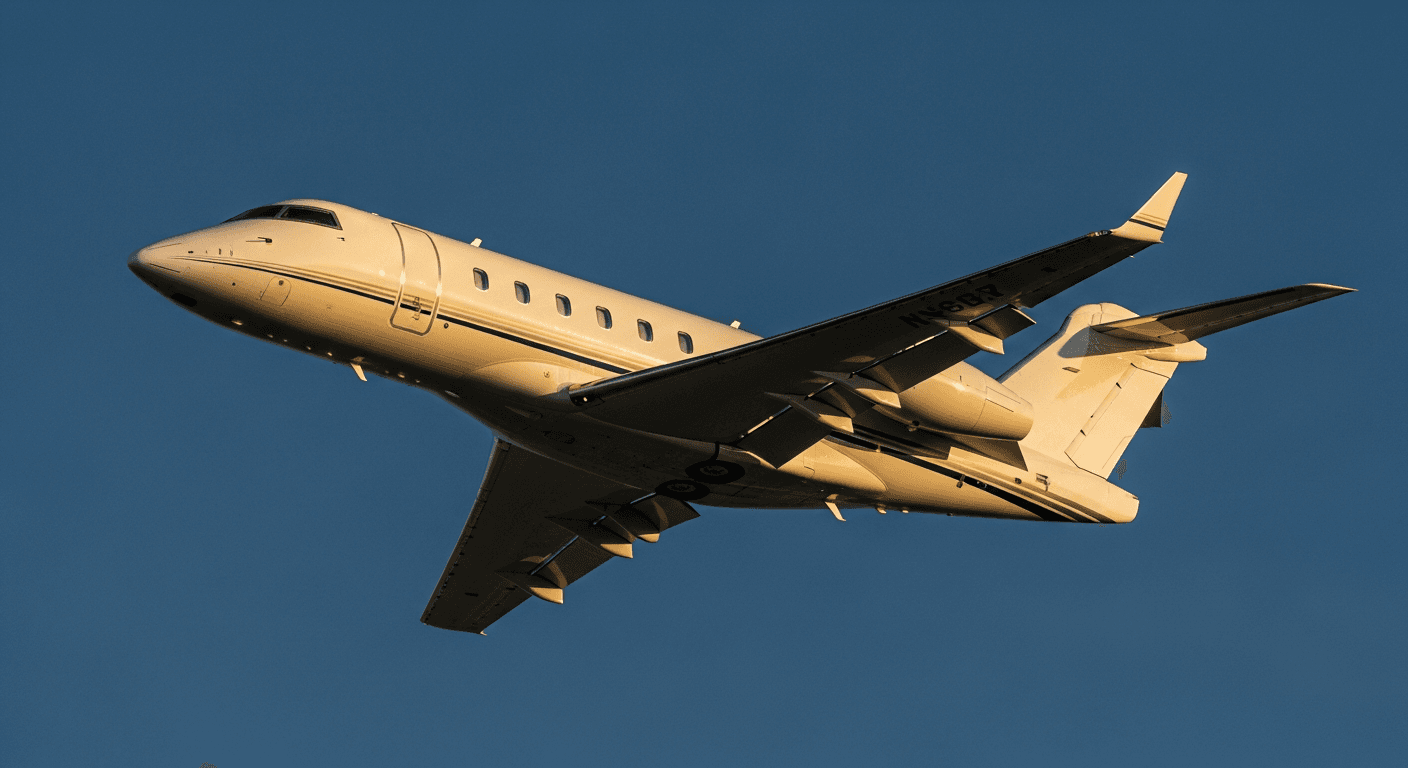
London to New York covers roughly 3,000 nautical miles westbound, a distance that rules out anything shorter-legged than a large-cabin aircraft once prevailing headwinds are factored in. A Bombardier Global 7500, with a manufacturer-quoted range of 7,700 nautical miles, or a Gulfstream G650ER, rated to 7,500 nautical miles, covers the sector nonstop with fuel to spare even against a strong jet stream, which matters in late September when Atlantic headwinds routinely run 80 to 120 knots.
Stepping down a category changes the calculation. A Bombardier Global 6000, rated to 6,600 nautical miles, still clears the crossing comfortably, while a Challenger 350, at 3,200 nautical miles, cannot make Teterboro from Farnborough without a technical fuel stop, typically at Bangor or Shannon, adding upwards of 90 minutes to total journey time.
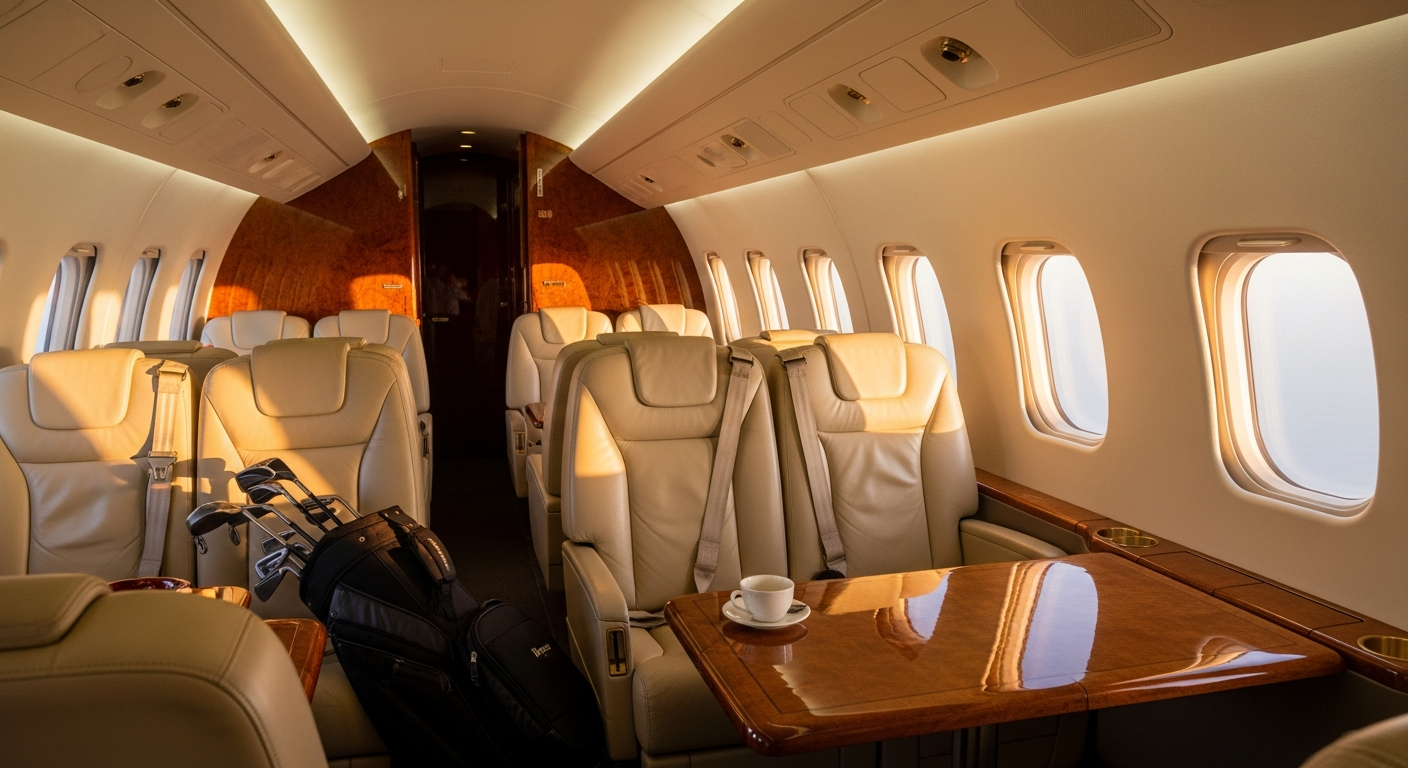
Cabin specification matters as much as range for this particular trip. Golf equipment travels in numbers on Ryder Cup week, and both the Global 7500 and G650ER carry an in-flight-accessible baggage compartment of around 195 cubic feet, enough for a full set of clubs per passenger alongside standard luggage without resorting to a second aircraft or freight.
Passenger capacity is the other variable worth checking before booking. The Global 7500 seats up to 19 across four distinct cabin zones on a 54-foot cabin length, useful for groups combining a corporate hospitality party with family travelling separately, while the G650ER seats up to 18 in a 46.8-foot cabin. A Dassault Falcon 8X, rated to 6,450 nautical miles with a 7-foot-8-inch cabin width against the Global 7500's 8-foot-2-inch, suits a smaller party happy to trade a little shoulder room for strong short-field performance.
A one-way charter from Farnborough (EGLF) to Teterboro (KTEB) on a Global 7500 runs £115,000 to £145,000 depending on aircraft age, positioning costs and how far ahead the booking is confirmed. A Gulfstream G550, with a shorter 6,750 nautical mile range but still comfortably nonstop capable, brings that down to roughly £90,000 to £115,000.
Slot Restrictions and Why September Bookings Need to Go In Now
Villiers has taken ryder cup private jet enquiries since March, and with the tournament now under three months away, ramp space at all three New York airports is filling faster than a typical autumn week in the city.
Teterboro operates under a Port Authority prior permission required system for any non-scheduled arrival, and FBOs there typically ask for 30 days' notice on a normal week. For the week of 21 to 28 September 2026, several ground handlers had stopped accepting new slot requests by late June, four months out from an event that would ordinarily need only a few weeks of lead time.
Westchester County adds a further layer: the airport enforces a noise-based curfew between 11pm and 6.30am with restricted exceptions, and its limited overnight parking means aircraft that arrive early in the week and stay through Sunday's closing ceremony occupy a ramp slot other operators are actively competing for. Overnight parking requests for the full tournament week were effectively gone by early July.
Republic Airport compounds the problem because its usable ramp space is smaller than either of the other two to begin with. A midsize jet parked there for four consecutive nights during Ryder Cup week takes up capacity that would otherwise turn over two or three times in a normal cycle, so operators there are rationing slots on a first-confirmed, first-served basis rather than a waiting list.
The practical upshot for anyone still weighing a ryder cup private jet trip this year is straightforward: aircraft type and airport choice need to be locked in now, with a deposit placed, rather than treated as a decision that can wait until August. Clients who confirm in the next fortnight still have a reasonable choice of aircraft category; clients who wait until September are likely to be told which airport they are using, not asked.
Building the Full Itinerary: Ground Transfers, Accommodation, and Extending the Trip
Ground transport from Teterboro or Westchester needs a race-week buffer of at least 30 minutes beyond the normal 55 to 75 minute drive, since the NYPD's rolling road closures around Bethpage State Park during peak spectator hours can add 45 minutes without warning on final-round Sunday.
Clients landing at Republic avoid nearly all of that uncertainty, which is the main reason the two-aircraft strategy, a long-range jet into Teterboro or Westchester followed by a short domestic hop, has become the preferred routing for anyone serious about minimising the risk of missing tee times.
Accommodation near Bethpage itself is limited to a handful of properties in Farmingdale and Melville, most of which were fully booked within days of the pairings and tee times being confirmed. The more workable pattern is basing the group in Manhattan, roughly 45 minutes from Bethpage outside tournament hours, or further east in the Hamptons, which suits clients planning to extend the trip beyond the closing ceremony.
A significant share of this year's charter clients are treating the Ryder Cup as one stop on a longer US itinerary rather than a standalone trip. The same Global 7500 or G650ER that made the Atlantic crossing has the range and cabin space to continue on to a second or third US city afterwards, whether that is a few days in the Hamptons, a swing through Palm Beach ahead of the autumn social calendar, or an onward domestic leg to the West Coast.
That flexibility is worth building into the original charter contract rather than negotiating separately once the group is already in New York. Confirming a multi-city itinerary before departure locks in the aircraft, the crew duty-time planning and the FBO slots for every leg at once, which is considerably more reliable than trying to add a second US sector after the aircraft and crew are already committed to a single return date.