
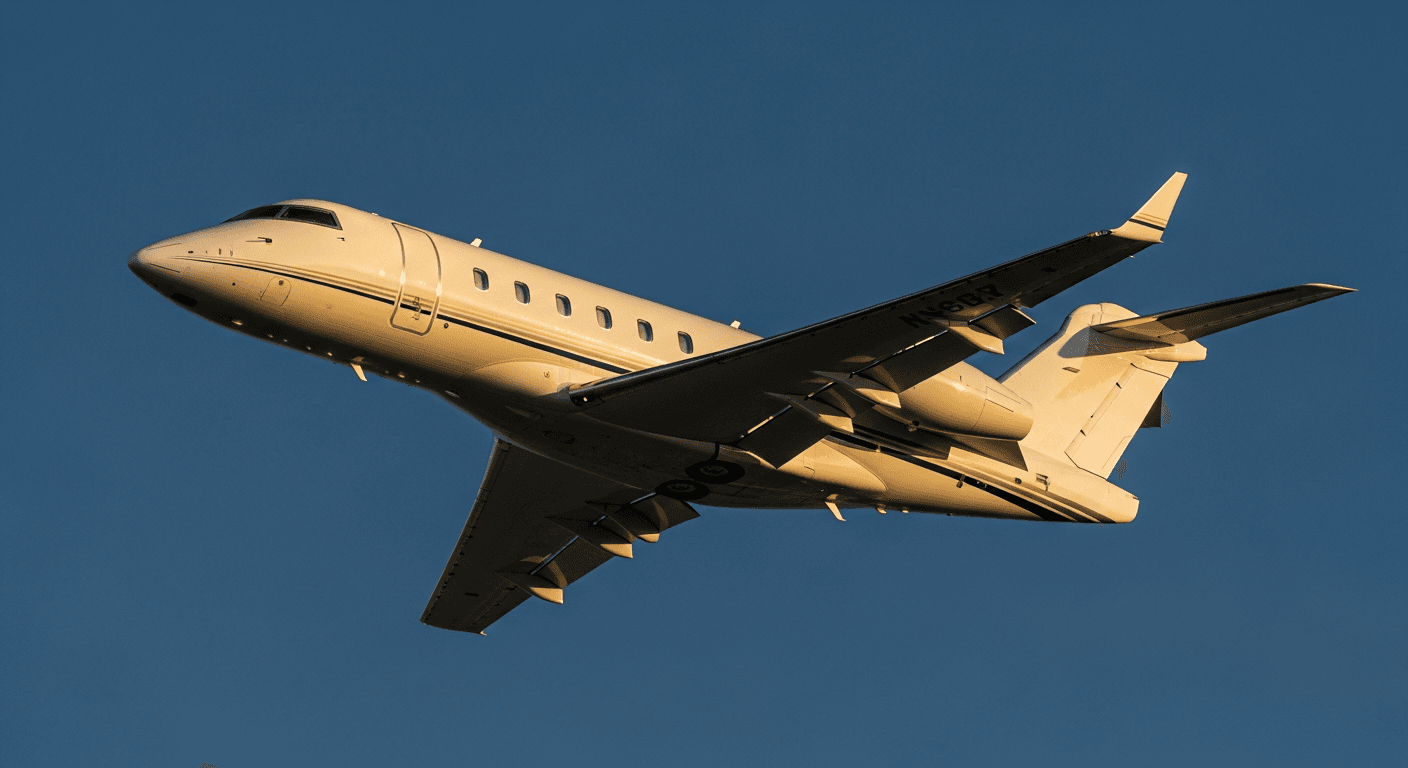
Why the Challenger 350 Has Become the Charter Market's Default Aircraft
Bombardier has delivered more than 700 Challenger 350s since the aircraft entered service in 2014, a volume that no other jet in the super-midsize category has come close to matching. That figure matters for charter clients because availability drives options: operators across Europe, the Middle East, and North America have built their fleets around this airframe, which means Bombardier Challenger 350 charter demand can almost always be met with a local operator and a short lead time.
The explanation for that dominance is not a single standout feature but a set of proportions that turned out to be unusually well-matched to how private clients actually travel. A cabin that seats eight to nine in genuine comfort, a range that covers virtually every European city pair and reaches the Gulf non-stop from Western Europe, and operating economics that allow operators to price competitively without sacrificing margin: these three factors, arriving together in one airframe, proved difficult for the market to resist.
The Challenger 350 also benefits from Bombardier's mature global support network; maintenance coverage across Europe and the Americas means that operators face fewer unscheduled groundings than they do with less widely adopted types.
Charter brokers and operators began standardising on the type through the mid-2010s, and the network effect compounded quickly. A busy super-midsize category that might once have split demand between three or four types now consolidates around one, which means finding a Bombardier Challenger 350 charter on a given route is a matter of hours rather than days.
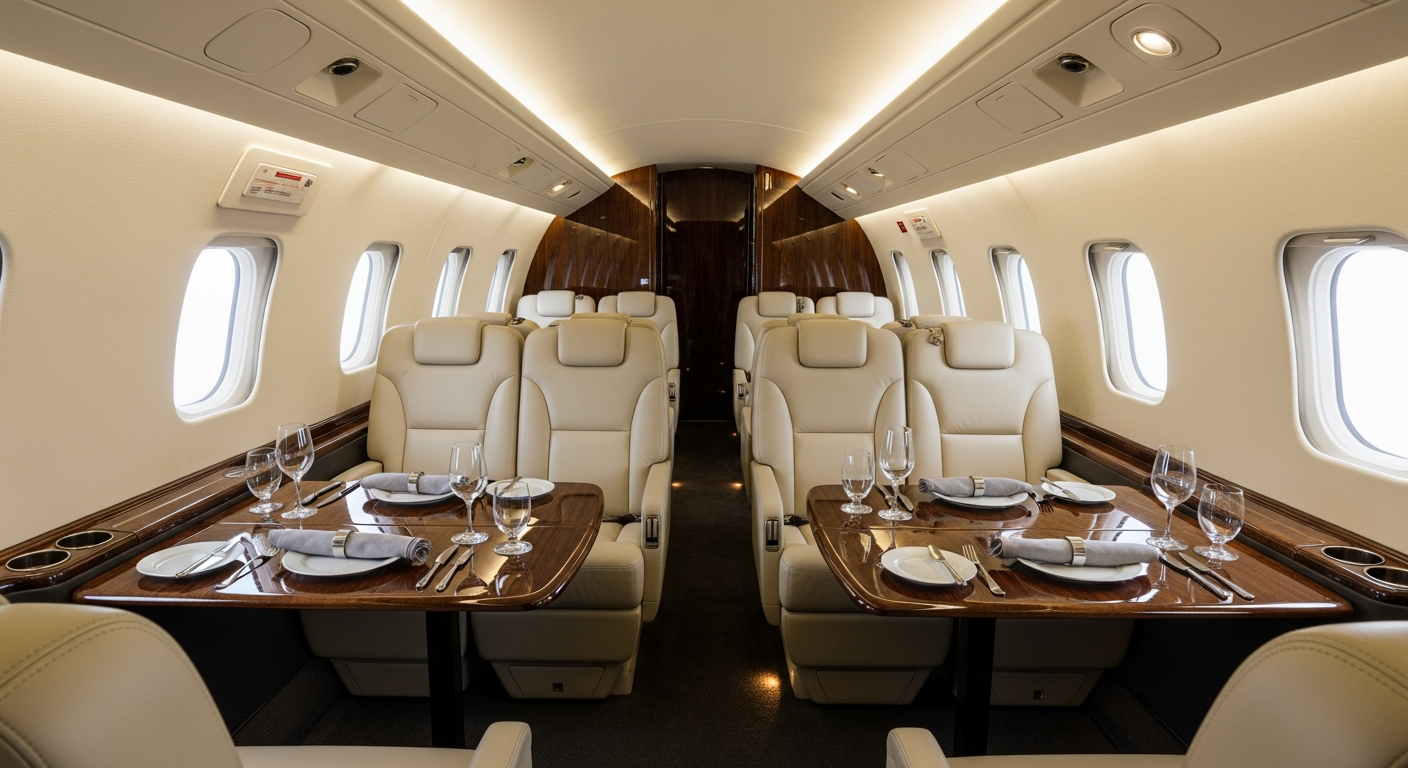
Cabin and Interior: What Eight Passengers Actually Experience On Board
At 7 ft 2 in wide and 6 ft 1 in tall, the Challenger 350 cabin is not the broadest in its class, but it is proportioned to avoid the compressed feeling that affects narrower midsize jets. A standard configuration seats eight passengers in a club arrangement of four pairs of facing seats, with a forward galley and a fully enclosed rear lavatory. The usable cabin length of 28 ft 6 in gives those eight seats adequate pitch without requiring passengers to shuffle sideways past one another.
Seat quality is a genuine strength. The standard chairs are wide, with good lumbar support and generous recline, and on the later production aircraft they allow passengers to work at the armrest table without repositioning frequently. For a two-to-three-hour sector, the format is entirely comfortable; for a five-hour flight, the lack of lie-flat capability becomes relevant for passengers who prioritise sleep.
The galley is positioned at the forward bulkhead and is functional rather than generous. Hot meal service is feasible on longer sectors, but the workspace constrains what crew can prepare; on shorter flights, catering boards and chilled items work better. The rear lavatory is properly enclosed and sized for a stand-up change, which is more than can be said for all competitors in the category.
In-flight connectivity is standard on most charter-configured aircraft in the fleet, with Wi-Fi coverage adequate for email and video calls on European routes. Seat-back screens and audio-visual systems vary by operator; ask specifically when booking if entertainment hardware matters, as configurations differ widely across the available pool.
Cabin noise at cruise is noticeably low for a jet of this size, a consequence of the Honeywell HTF7350 engines mounted well aft of the pressure vessel. Passengers who use noise-cancelling headphones will find conversation effortless; those who do not still find conversation manageable.
Range, Speed, and Performance: The Routes It Was Built For
The Challenger 350 carries a maximum range of approximately 3,200 nautical miles at standard payload, placing it in a tier that spans London (EGLF Farnborough) to Dubai (OMDB), Edinburgh (EGPH) to Tel Aviv (LLBG), and Lisbon (LPPT) to the Maldives with a single technical stop. Cruise speed at Mach 0.82 translates to roughly 520 knots true airspeed at altitude, which places London to Moscow (UUEE Sheremetyevo) at around three hours ten minutes and London to Nice (LFMN) at under ninety minutes.
The transatlantic sector is where the aircraft's range meets its practical limit. London to New York's Teterboro (KTEB) sits at approximately 3,450 nautical miles, slightly beyond the aircraft's unassisted reach with a full passenger load. A single technical stop, typically at Reykjavik (BIRK) or Gander (CYQX), adds roughly forty-five minutes to the total journey time but remains operationally straightforward. For clients whose trip incorporates a transatlantic leg followed by additional US sectors, the stop can be folded into the schedule as a fuel and crew call rather than a disruption.
Clients planning a non-stop westbound crossing from Western Europe should consider a larger cabin type, specifically the Bombardier Global 5500 or the Gulfstream G550.
For the routes where the aircraft is ideally matched, sector costs are competitive. A Farnborough (EGLF) to Geneva (LSGG) one-way sector costs roughly £15,000 to £20,000; London to Cannes or Nice runs to £18,000 to £26,000 depending on date and operator; a London to Dubai sector, among the longest routes within the aircraft's range envelope, typically reaches £55,000 to £70,000 at current market rates. These figures assume a single operator quote for a one-way charter and will vary with repositioning distance, fuel prices, and seasonal demand.
The aircraft's service ceiling of 45,000 feet allows it to route above the weather systems that affect mid-altitude jets and access favourable winds on longer sectors. Operators consistently report better-than-published block times on North Atlantic staging legs and Southern European routes in summer.
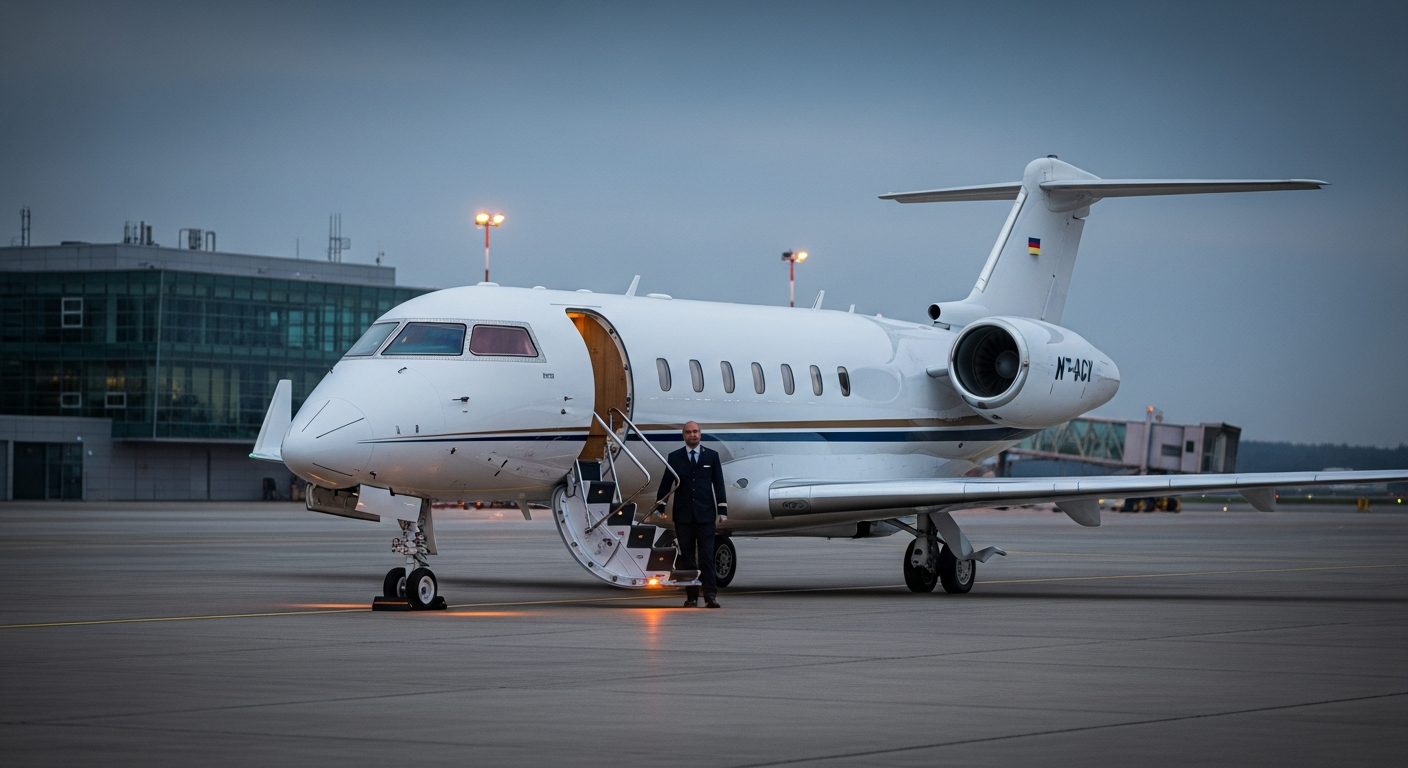
Challenger 350 vs Challenger 3500: Understanding Bombardier's Update
Bombardier launched the Challenger 3500 at NBAA 2021, with the first deliveries following in 2022. From a performance standpoint, the aircraft is effectively identical to its predecessor: the same range, the same engines, the same speed envelope, and the same certified payload. Clients evaluating a Bombardier Challenger 350 charter alongside a Challenger 3500 quote are comparing two aircraft that will reach the destination at the same time.
The update lives entirely in the cabin. Bombardier equipped the 3500 with the Nuage seating package developed initially for the Global 7500, which introduced a new seat geometry, improved cushioning, and a more considered headrest design. The cabin lighting system was upgraded to a full LED scheme with programmable presets, the interior surfaces received new materials and finish options, and the touchscreen cabin management interface was modernised.
For passengers who board unaware of the distinction, the 3500 feels more polished: the seats are visually distinctive and the materials read more premium at first contact. Whether that difference justifies a charter premium of ten to fifteen per cent over an equivalent 350 depends entirely on the passenger's priorities. For a forty-five-minute sector, no reasonable client should pay the difference; for a five-hour overnight sector where the seat defines the experience, the 3500's refinements earn their cost.
Operators who took delivery of 3500s from 2022 onwards have begun quoting them at a slight premium. The practical advice: ask your broker whether the aircraft on quote is a 350 or a 3500, then judge the premium against the flight duration.
How It Compares to the Competition, and When to Choose Something Else
The Challenger 350's closest rivals in the super-midsize category are the Cessna Citation Longitude, the Embraer Praetor 600, and the Dassault Falcon 2000LXS. Each positions differently.
The Citation Longitude offers a cabin 6 ft 2 in wide by 6 ft 0 in tall, a foot narrower than the Challenger 350's 7 ft 2 in cross-section; passengers sitting two abreast notice the reduced shoulder room on longer sectors. Its published range of 3,500 nautical miles gives it a slight reach advantage, and the interior finish on recent production aircraft is competitive. For operators with a strong maintenance record on the type, it is a credible alternative.
The Embraer Praetor 600 offers a certified range of 4,018 nautical miles, meaningfully longer than the Challenger 350, and is capable of a non-stop London to New York sector under favourable load conditions. Its cabin seats up to twelve passengers, though ten is more realistic for longer journeys with full catering. For clients whose routing consistently extends beyond 3,200 nautical miles, the Praetor 600 makes a strong case.
The Dassault Falcon 2000LXS carries a published range of 4,000 nautical miles and benefits from the Falcon series' reputation for interior quality and ride smoothness. It is less commonly available on the charter market in most European regions, which means repositioning costs can offset its range advantage on asymmetric routings.
When to step down: for a group of three or four on a sub-two-hour European sector, the Embraer Phenom 300E delivers a comparable journey at meaningfully lower cost. The Phenom's cabin measures 5 ft 1 in across, seats up to eight passengers, and is best suited to groups of five or fewer when luggage and in-flight comfort on longer legs are considered.
When to step up: for groups exceeding nine, for routes beyond 3,200 nautical miles without a planned stop, or for clients who require lie-flat seating, the Bombardier Global 5500 or the Gulfstream G550 are the natural next tier. Both carry charter rates typically 60 to 80 per cent above Bombardier Challenger 350 charter pricing on comparable sectors, but the additional cabin volume and non-stop transatlantic range justify the premium when the routing demands it.
The Challenger 350 earns its dominance not by leading in any single dimension but by combining range, cabin comfort, availability, and operational consistency at a price point that works for more sectors than any single competitor. For a seasoned broker, it is the starting recommendation; the question is only whether a specific routing or group profile warrants a departure from it.