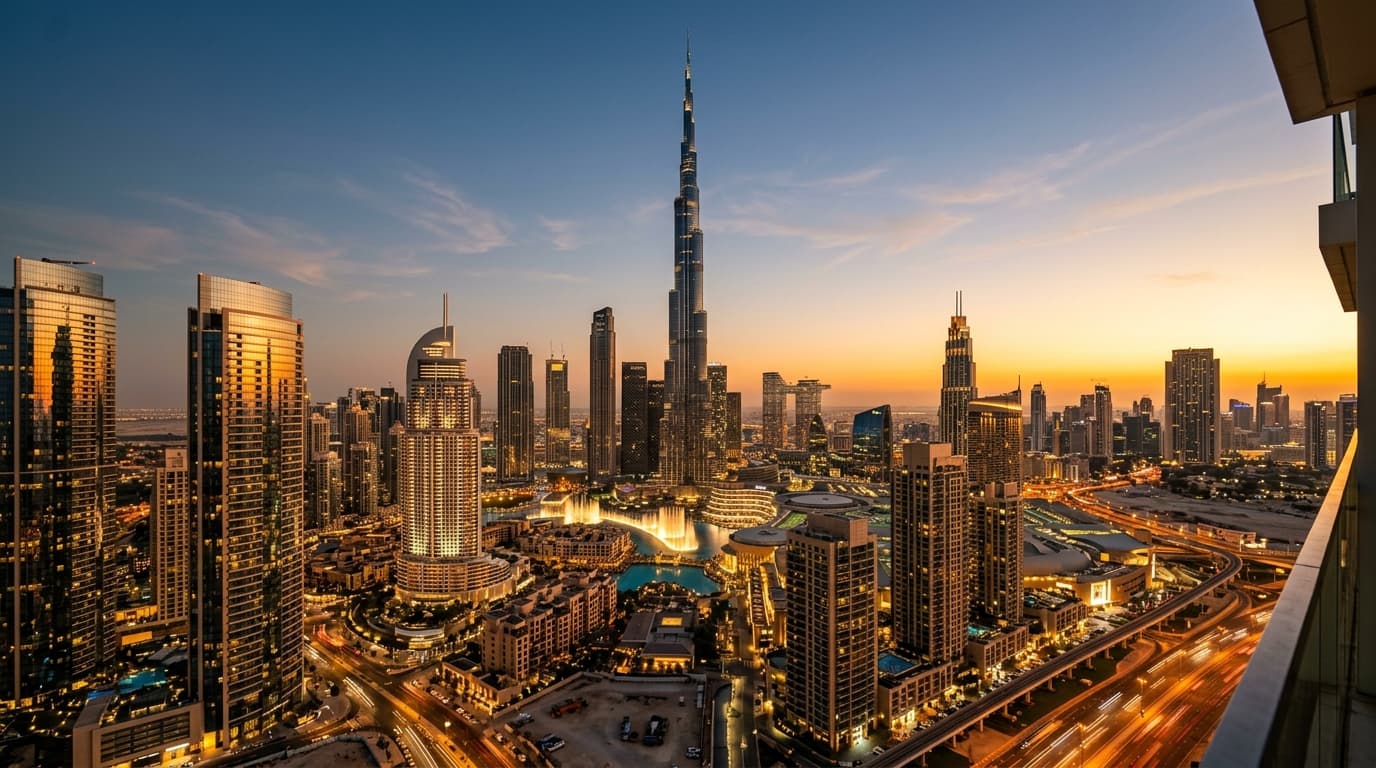
Why Dubai Is a Private Aviation Capital in Its Own Right
Al Maktoum International, ICAO code OMDW, was built with a business aviation ramp that outsizes the general aviation footprint of London's three main executive airports combined, and Dubai now receives more private jet movements each winter than any city outside Europe and North America.
That volume is not an accident of geography. Dubai sits within an eight-hour flight radius of roughly two-thirds of the world's population, which makes it a natural staging post between Europe, the Indian subcontinent, and East Asia rather than simply a holiday endpoint.
For operators booking out of the UK, private jet Dubai routing has become one of the most reliably filled long-haul sectors on the calendar. A resident population of ultra-high-net-worth families, a business calendar built around the DIFC financial district, and a winter events season running from October through April all keep demand steady well beyond the obvious leisure window.
Regulatory speed helps too. Permits and overflight clearances for the UAE are typically confirmed faster than for several European short-haul destinations, and Dubai's General Civil Aviation Authority processes private arrivals with a professionalism that has become the regional benchmark.
Dubai also competes directly with Riyadh and Doha for Gulf-based business traffic, but its head start in dedicated business aviation infrastructure, built years before either rival broke ground on comparable facilities, is what keeps charter desks defaulting to Dubai first when a client asks for a Gulf stopover or a standalone visit.
The mix of visitors reflects that infrastructure edge. Family offices relocating capital toward DIFC, art collectors timing trips around Alserkal Avenue openings, and yacht owners staging crews between the Gulf and the Maldives all move through the same handful of FBOs, which keeps those operators fluent in exactly the kind of fast, low-friction service a first-time Dubai client expects from a broker.
DXB vs Al Maktoum (DWC): Choosing the Right Airport for a Private Arrival
Dubai International, ICAO code OMDB, still handles the bulk of scheduled commercial traffic into the city, and it remains where the Dubai Jet Centre FBO operates for business aviation clients who need to be close to Downtown Dubai or DIFC.
The catch is capacity. DXB runs close to its practical slot ceiling for most of the year, which means private arrivals are routinely sequenced behind widebody commercial traffic, and short-notice slot requests inside 48 hours are frequently declined outright during the winter season.
Al Maktoum International, roughly 37 kilometres southwest of Downtown Dubai near Jebel Ali, was designed from the outset as a business and cargo aviation hub with far less scheduled traffic to compete against. Ground handlers at DWC can typically turn an arriving crew from touchdown to car in under twenty minutes outside peak event periods, against closer to forty-five minutes at DXB during a busy afternoon.
The trade-off is transfer time. DXB puts clients roughly 15 to 20 minutes from Downtown Dubai and DIFC by road; DWC adds another 25 to 35 minutes depending on traffic on Sheikh Zayed Road. For a client staying at a Palm Jumeirah resort or attending meetings in DIFC on a tight schedule, that extra 30 minutes is often enough to justify booking DXB slots well in advance rather than defaulting to DWC.
There is also a longer-term consideration. Dubai's aviation authorities have signalled plans to expand DWC into the emirate's primary airport over the coming decades, eventually taking on the bulk of the traffic DXB carries today, so operators who build relationships with DWC's FBOs now are positioning clients ahead of that shift rather than reacting to it later.
Our rule of thumb: if the visit is leisure-led and the client is staying anywhere near Dubai Marina or Jumeirah, DWC's shorter ground handling queue outweighs the longer transfer. If it is a same-day business trip built around DIFC meetings, DXB is worth the earlier slot request.
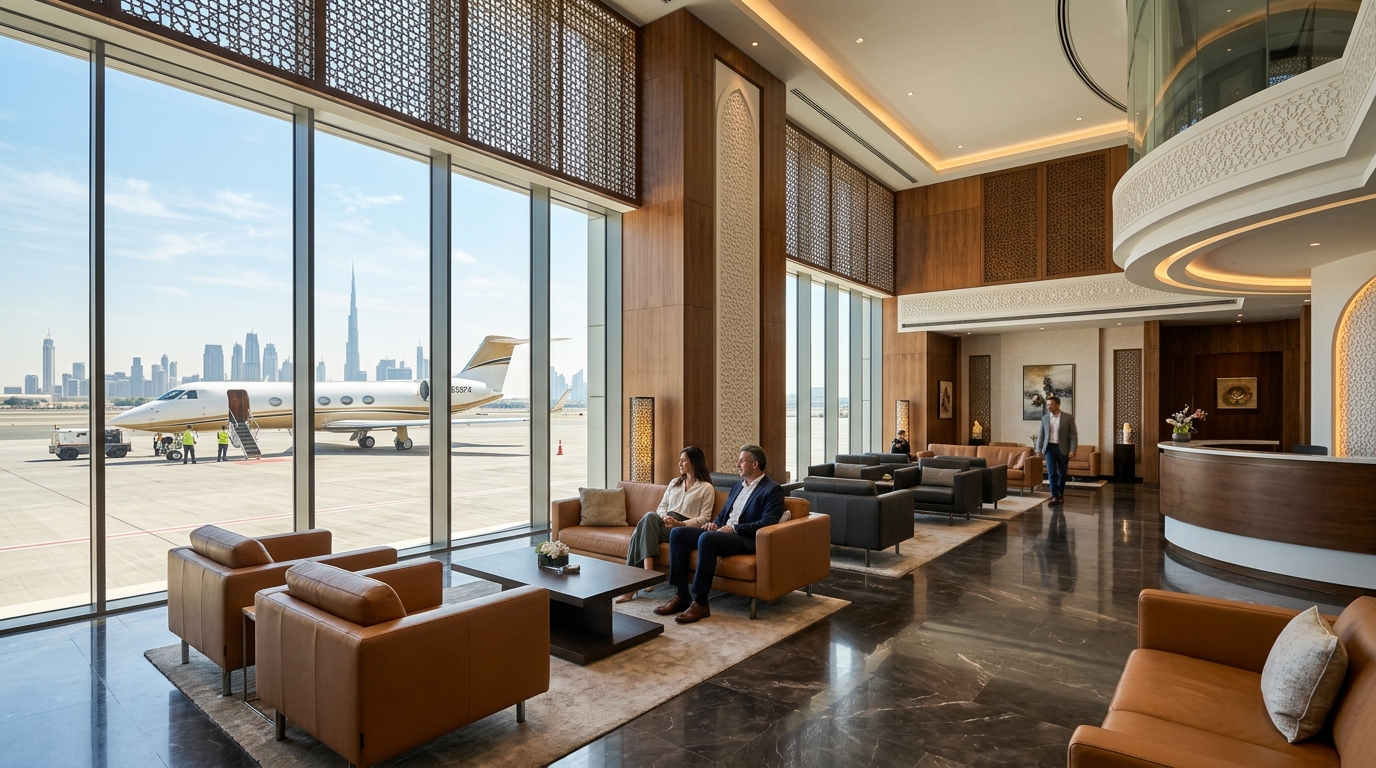
Aircraft Choice for London–Dubai: Matching Cabin and Range to a Seven-Hour Sector
London to Dubai is a genuine long-range sector at just under 2,950 nautical miles, which rules out most midsize cabins, typically rated to 3,000 to 3,500 nautical miles with full fuel reserves, from a comfortable nonstop routing once winter headwinds are factored in.
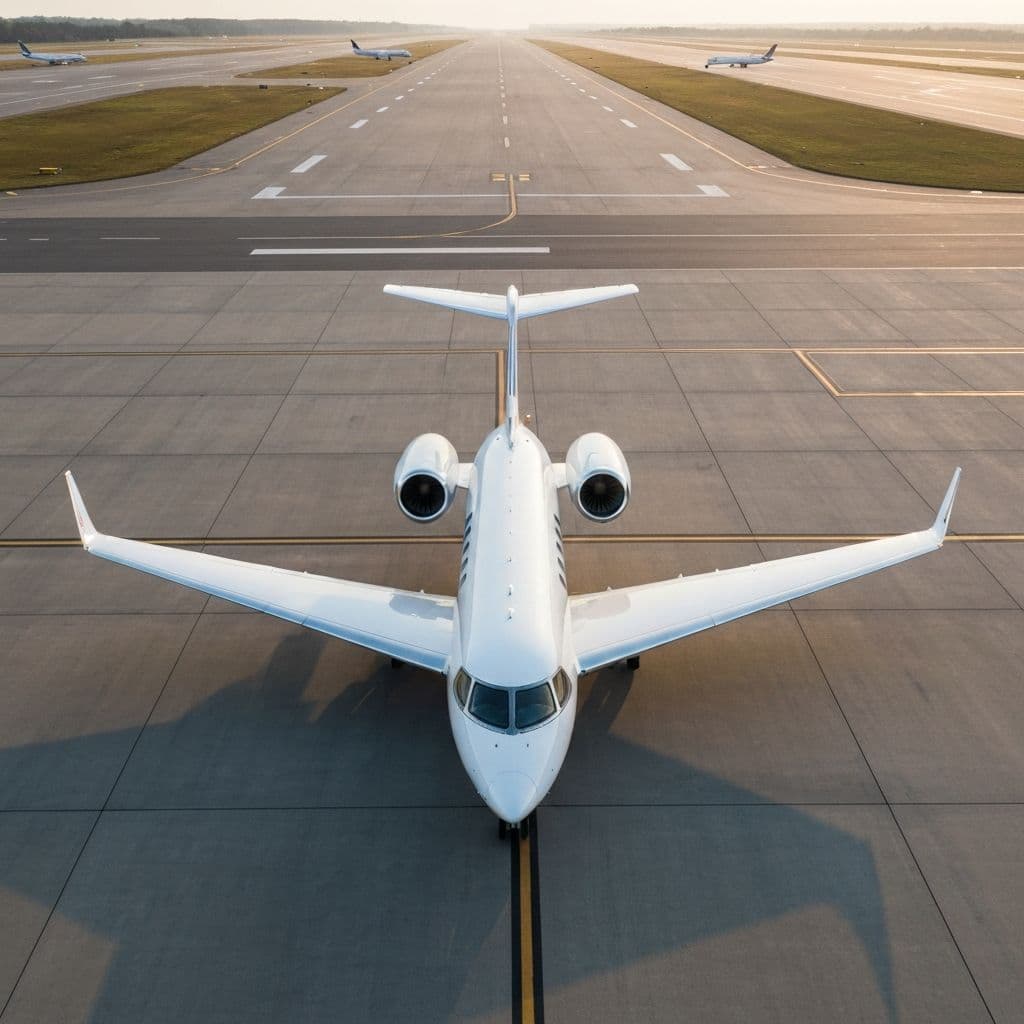
The Gulfstream G650ER and the Bombardier Global 7500 are the two aircraft most UK charter desks reach for on this city pair. Both have the range, at 7,500 nautical miles and 7,700 nautical miles respectively, to cover London to Dubai with generous headwind reserves, and both offer a stand-up cabin with a separate stateroom, which matters on a sector that regularly runs six and a half to seven hours.
The cabins are not identical. The Global 7500's interior runs to 54 feet 5 inches in length, the longest in the ultra-long-range category and enough for four distinct living spaces, against the G650ER's 44 feet 6 inches and typically three zones. For a group of six to eight, the practical difference is how many people can work, dine, and rest simultaneously without sharing a zone, rather than outright legroom.
For groups of eight or fewer prioritising cabin comfort over ultimate range, the Dassault Falcon 8X and Gulfstream G550 remain credible alternatives. The Falcon 8X's 6,450 nautical mile range and three-lounge layout suit clients who want genuinely separate work, dining, and sleeping zones across a long sector; the G550, an older but still well-regarded platform, covers the distance with roughly an hour's fuel reserve to spare against typical winter jet stream headwinds.
Super-midsize aircraft such as the Bombardier Challenger 350 are not a sensible choice for this specific sector. Its 3,200 nautical mile range leaves little margin against headwinds on the London to Dubai routing and often forces an unplanned technical stop, which defeats the point of chartering a private jet Dubai service in the first place.
Pricing reflects the category jump. A one-way London to Dubai charter on a heavy jet such as the Gulfstream G650ER or Bombardier Global 7500 typically runs £48,000 to £68,000 depending on aircraft age, operator, and how far in advance the booking is confirmed; the Falcon 8X and G550 usually price £6,000 to £10,000 lower on the same routing.
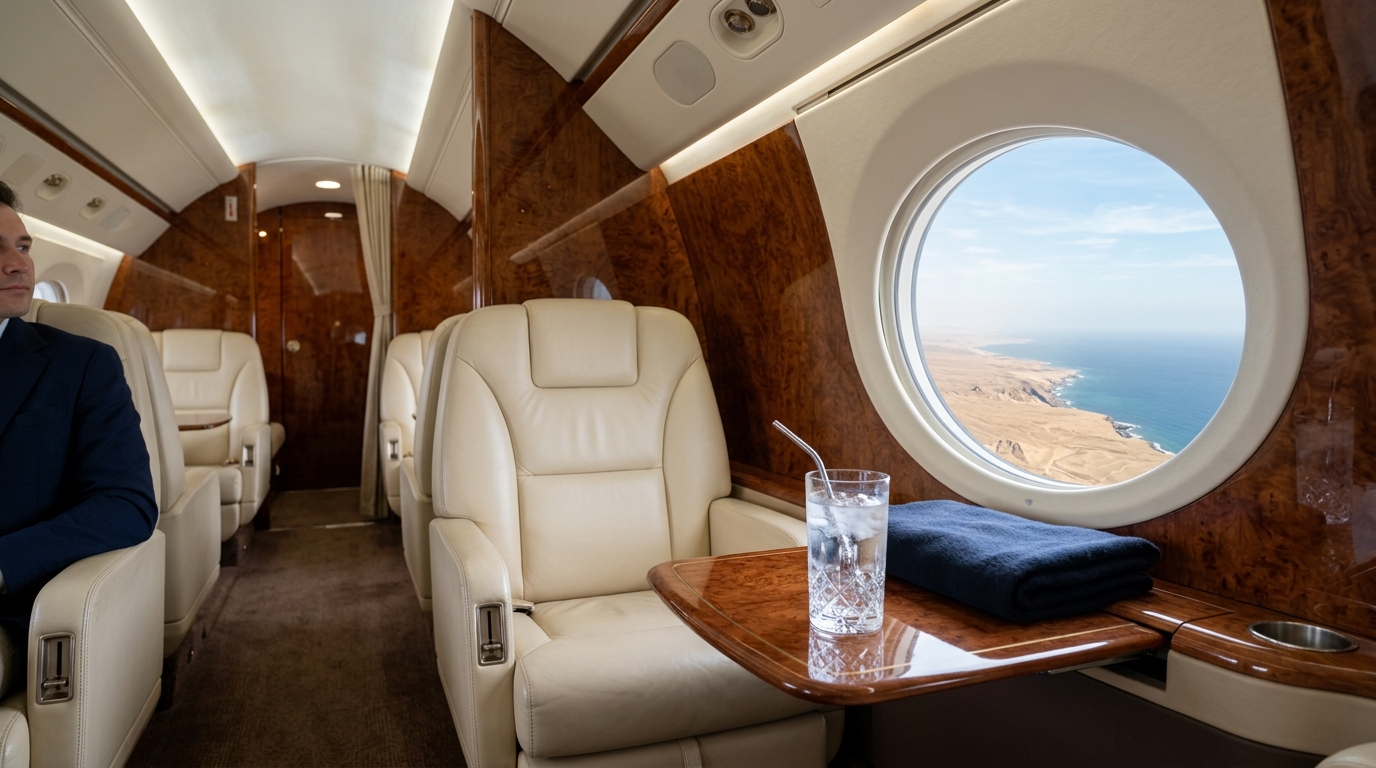
Timing It Right: Peak Season, the MEBAA Show, and Slot Pressure at DWC
Dubai's private aviation calendar peaks hard between November and March, when daytime temperatures sit in the low-to-mid twenties Celsius rather than the 40-plus heat of a Gulf summer.
Booking a private jet Dubai slot inside that window without at least two to three weeks' notice is increasingly difficult, particularly for arrivals timed around New Year's Eve, when the Burj Khalifa fireworks display draws a concentrated wave of private arrivals into both DXB and DWC over a 72-hour period.
The Middle East Business Aviation Association show adds a second, sharper spike. Held biennially at DWC, MEBAA turns the airport's ramp into static display space for several days, which materially reduces the transient parking available to visiting aircraft and pushes handlers to request slot confirmations further ahead than usual.
Clients flying in for the Dubai World Cup at Meydan in late March face a similar squeeze on a smaller scale, as does the week around Art Dubai in the same month. Ramadan brings the opposite effect: business meeting schedules compress into shorter working hours, but leisure arrivals and ramp congestion both ease noticeably, which makes it a useful window for clients with flexible dates.
The practical threshold: for any Dubai arrival falling within ten days either side of MEBAA or New Year's Eve, confirm the slot and FBO handling booking a minimum of three weeks ahead. Outside those windows, one to two weeks' notice is usually sufficient for either airport.
On the Ground: FBOs, Customs, and What Discretion Actually Looks Like in Dubai
Jetex and ExecuJet both operate dedicated FBO terminals at DWC, and each offers a private immigration desk that lets passengers clear customs inside the FBO lounge rather than in a shared terminal hall.
At DXB, the Dubai Jet Centre provides the equivalent service, with passport control staff attending the aircraft or the FBO suite directly for clients who have arranged it in advance through their handler.
Discretion in Dubai is less about opaque glass and more about process. Manifest details are handled by the FBO and the operator's ground handling agent before arrival, so passengers are rarely asked to present documentation in a public queue, and vehicle access to the apron means a client can go from cabin door to a waiting Range Rover without transiting a public concourse at all.
Customs for accompanied baggage is generally straightforward for leisure travellers, though the UAE maintains strict rules on cash declarations above AED 60,000, roughly £13,000, and on any commercial quantity of goods, so clients travelling with high-value items or business samples should brief their handler in advance rather than assume FBO discretion extends to bypassing declarations.
That combination, purpose-built FBO infrastructure, private immigration processing, and apron-level vehicle access, is what separates a well-briefed private jet Dubai arrival from a merely comfortable one. The aircraft gets a client to the Gulf in seven hours; the ground plan is what decides whether the next thirty minutes feel like an extension of that same private experience or a return to a public queue.