Royal Ascot 2026: Dates, Days That Matter, and Why Logistics Get Tight
Farnborough's slot book for Gold Cup Day 2026 will be effectively full by mid-March, roughly thirteen weeks before the Royal Procession first crosses the heath. That isn't a forecast; it's a pattern repeated every year since the airport's GA traffic recovered in 2022, and it sets the tone for everything else about flying in for the meeting.
The meeting runs from Tuesday 16 to Saturday 20 June 2026. Five afternoons, each opening with the Royal Procession at 2pm and closing after the last race around 6pm. The marquee days are Wednesday with the Prince of Wales's Stakes, Thursday's Gold Cup and Ladies Day combined, and Saturday's finale, although Tuesday draws the heaviest concentration of helicopter movements before lunch.
Around 300,000 racegoers attend across the week, and a significant proportion fly in and out the same day. The result: morning arrivals between 9:30 and 12:30 saturate every London-region GA airport, and the 5pm to 8pm departure window is busier still as the on-course helipad clears.
The bell curve across the week tilts heavily towards Wednesday and Thursday. Tuesday's opening attracts a higher proportion of returning regulars who fly in and out the same day, Wednesday brings corporate-hospitality groups who often stay overnight at Cliveden or Coworth Park, and Thursday concentrates jewellers, royal-watching media, and the most demanding helicopter sequencing of the meeting. Saturday relaxes by comparison, and Friday is the quietest day of the meeting for private aviation traffic, sometimes by a factor of two.
For a Royal Ascot 2026 private jet booking, the operative deadline is not the day before; it is March. Anyone calling in May for a Thursday slot at Farnborough is already late.
Choosing Your Airport: Farnborough, Luton, Biggin Hill, and the Heathrow Question
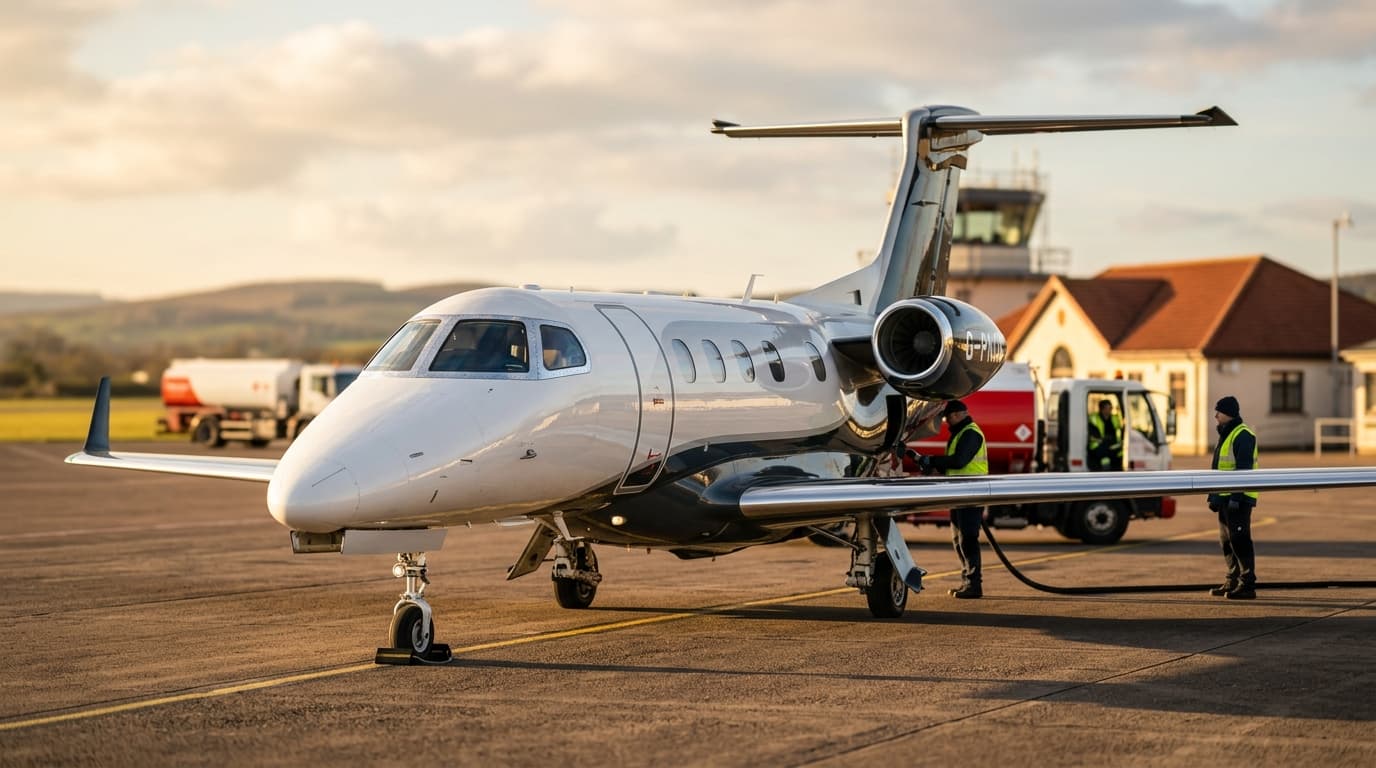
EGLF (Farnborough) sits roughly 17 nautical miles south-west of the racecourse, around 25 minutes by car if traffic behaves and 8 minutes by helicopter. It is the default choice for private aviation into Ascot, which is precisely why slot pressure is fiercest here. Handlers TAG Aviation and Gama close out their morning books first, generally Wednesday and Thursday before any other day.
EGGW (Luton) lies 45 miles north of the course. Road transfer is realistic at 60 to 90 minutes outside rush windows, but helicopter from Luton's apron to Ascot is around 15 minutes. Signature and Harrods Aviation handle the GA traffic and tend to hold slot availability later than Farnborough, sometimes into late April.
EGKB (Biggin Hill) is the south-east London option, 50 miles from the racecourse, 18 minutes by helicopter. Mid-week availability is usually better than at EGLF, and the FBO experience at Biggin's main terminal is among the calmer offerings at peak demand.
EGLL (Heathrow) deserves brief treatment, mostly to discourage it. Heavy jets can be accommodated, but landing slot fees during the meeting are punishing, GA handling is limited to a single FBO with constrained capacity, and taxi times to the racecourse stretch beyond an hour. Heathrow makes sense only if you are continuing to a central London base before transferring to Ascot the following morning.
RAF Northolt (EGWU) is sometimes proposed as a fifth option, sitting closer to central London than any of the alternatives. In practice it is rarely useful for Ascot: military priority means civilian slots are hard to confirm in advance, opening hours are constrained, and road transfer to the racecourse is no faster than from EGGW. Reserve it for clients with existing arrangements rather than treating it as a primary route in.
Jet-to-Helicopter Transfers: Booking the On-Course Pad and Timing the Procession
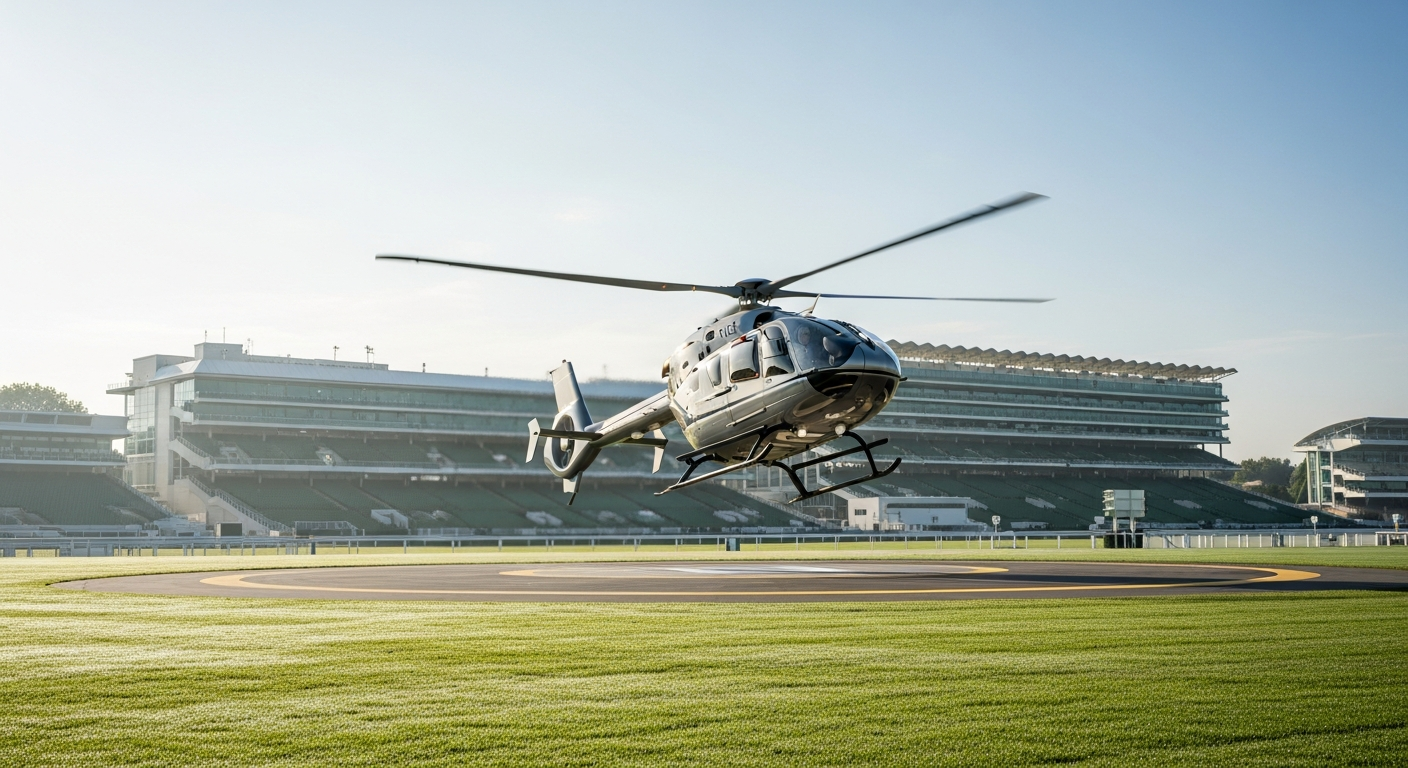
The on-course helipad at Ascot is the most constrained piece of infrastructure in the entire chain. CAA and Ascot Authority rules cap movements at roughly 240 per day, and operations halt entirely during the Royal Procession window between 1:55 and 2:05pm. No exceptions. A helicopter sequenced for 1:58 will simply not lift.
Slot allocation runs through Ascot's helicopter coordinator and the operator network: Castle Air, Heli Air Services, and Atlas Helicopters handle the bulk of the traffic. Aircraft are typically the AW109 SP, AW169, and EC130 T2 for two-to-six passenger groups. The pad opens at 11:00 and the last departure is around 19:30, which compresses outbound traffic into a tight three-hour window after racing concludes.
Sequencing the jet leg: aim to land at EGLF, EGKB, or EGGW with at least 90 minutes of buffer before the helicopter slot. Taxi and customs at Farnborough on Gold Cup morning routinely add 25 to 40 minutes versus a quiet weekday. Helicopter transfer is then a 7 to 18 minute hop depending on origin airport.
The clean architecture for a Tuesday Royal Procession arrival looks like this: jet wheels-down by 10:30, FBO formalities and changing facilities until 11:30, helicopter lift by 12:00, on-course helipad by 12:15, paddock by 12:45.
Two contingencies are worth pre-arranging. First, if the helipad closes unscheduled for weather or an incident, the fallback is a road transfer from the operator's primary base, typically Fairoaks or Blackbushe, adding 35 to 60 minutes depending on traffic. Second, if your jet slips its arrival window, the helicopter slot is forfeit; some operators hold a second-call slot pool for this exact scenario, but it must be requested at booking, not negotiated on the day.
Aircraft Sizing for the Meeting: Day-Trip Light Jets vs Group Midsize Charters
Light jets handle most one-day attendance. The Embraer Phenom 300E carries six passengers in club configuration with a baggage hold of around 76 cubic feet. That is adequate for a four-passenger group with morning dress and hat boxes, tight for six. The Cessna Citation CJ4 offers similar capacity with marginally more cabin width, and is the workhorse for short-sector European arrivals into London.
For groups of seven to nine, midsize lift becomes essential. The Cessna Citation Longitude carries up to 12 passengers with 112 cubic feet of baggage volume, a meaningful upgrade for a corporate party bringing morning suits, hats, and changes for evening engagements. The Embraer Praetor 600 and Bombardier Challenger 350 are direct alternatives, the Praetor offering the largest stand-up cabin in the segment.
Groups of ten or more, or international parties combining London pickups with continental origins, justify heavy lift. The Dassault Falcon 2000LXS, Bombardier Global 5500, and Gulfstream G500 all carry the cabin volume to handle a fully kitted-out racing party with room for a steward to serve breakfast en route from Geneva or Nice.
Range planning for a same-day return to the Continent is straightforward in this segment. A Phenom 300E covers Geneva to London with reserves for a diversion, the Citation Longitude reaches Vienna, and the Falcon 2000LXS handles Athens or Marrakech if the schedule demands it. The constraint is rarely range; it is crew duty time, particularly on a Saturday Coronation Stakes return when arrivals into LFPB or LSGG can run past 21:00 local.
A practical note on Royal Ascot 2026 private jet itineraries: the right aircraft is rarely the largest one available. A Phenom 300E for four passengers from Paris-Le Bourget (LFPB) costs roughly £14,000 to £17,000 for the day's positioning and return; a Challenger 350 for the same group runs £28,000 to £34,000. Pay for cabin space you will actually use.
Dress Code, Enclosures, and What Your Crew Needs to Know Before You Land
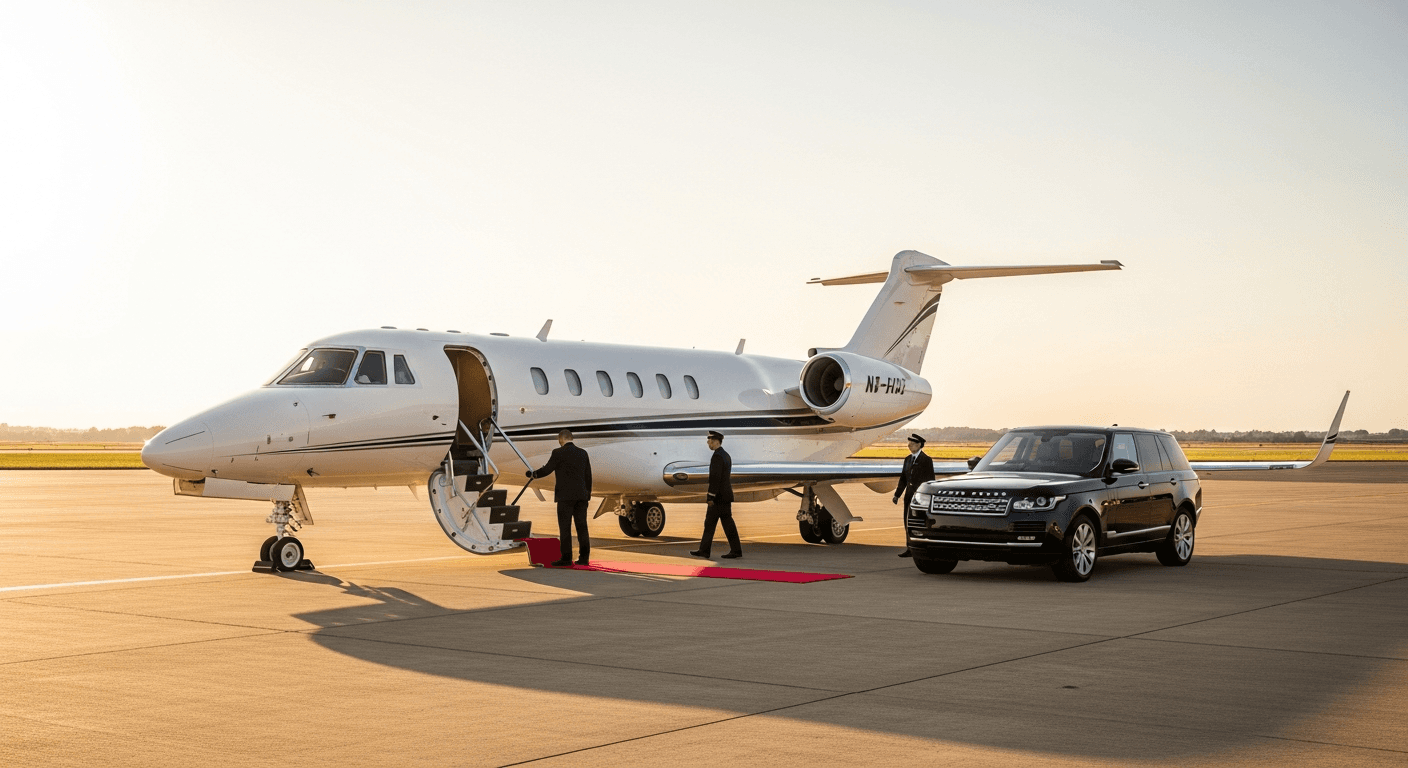
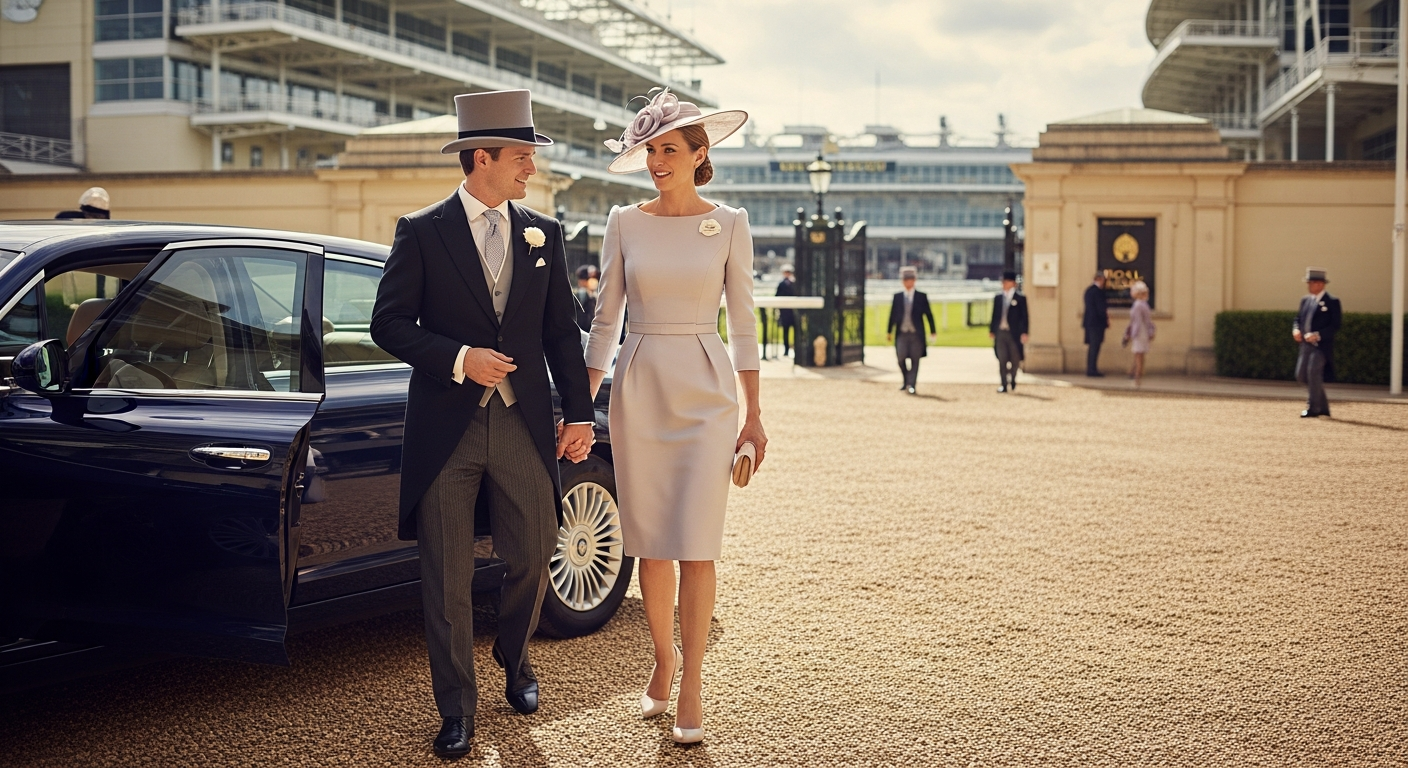
The Royal Enclosure dress code begins at the FBO doors, not the racecourse gates. Morning dress for men means a black or grey morning coat, waistcoat, formal trousers, top hat, and tie. For women: a dress with straps at least one inch wide and a hat with a base of four inches or more in diameter. Fascinators are not permitted.
The Queen Anne Enclosure is less formal but still smart, and the Village Enclosure asks for smart dress with a hat or fascinator. Most charter clients are heading for the Royal Enclosure, so the working assumption should be that all passengers want to disembark already dressed.
This places specific demands on the cabin and the FBO. Hat box stowage matters more than usual: a Phenom 300E baggage hold fits roughly four to five large hat boxes before infringing on overnight bags, and a midsize Citation Longitude or Praetor 600 is the realistic minimum for any group bringing five or more substantial pieces of headwear.
Brief the cabin crew on hot pressing and lint rollers for morning coats, flat lays for wide-brim hats, and on stowing morning dress for the return leg, when most passengers will have changed before boarding. FBO suites at EGLF and EGGW offer changing facilities, but they should be booked at the time of slot confirmation, not on the morning.
Post-race logistics deserve their own paragraph. Most racing parties continue to a London restaurant for dinner, with Mayfair and Knightsbridge as the dominant destinations. The cleanest sequence: helicopter from the on-course pad to Battersea (EGLW) at 18:30, ground transfer to the restaurant by 19:15, dinner from 19:45. Trying to route back to Farnborough or Luton for an immediate jet departure adds a road leg afterwards and rarely saves time.
A final note on a Royal Ascot 2026 private jet day: weather. June at Ascot has form for sudden showers, and morning suits do not respond well to rain on a hot helipad. Building a 30-minute weather margin into helicopter sequencing is the difference between arriving for the Royal Procession dry, on time, and ready, and arriving wet, late, and conspicuous.