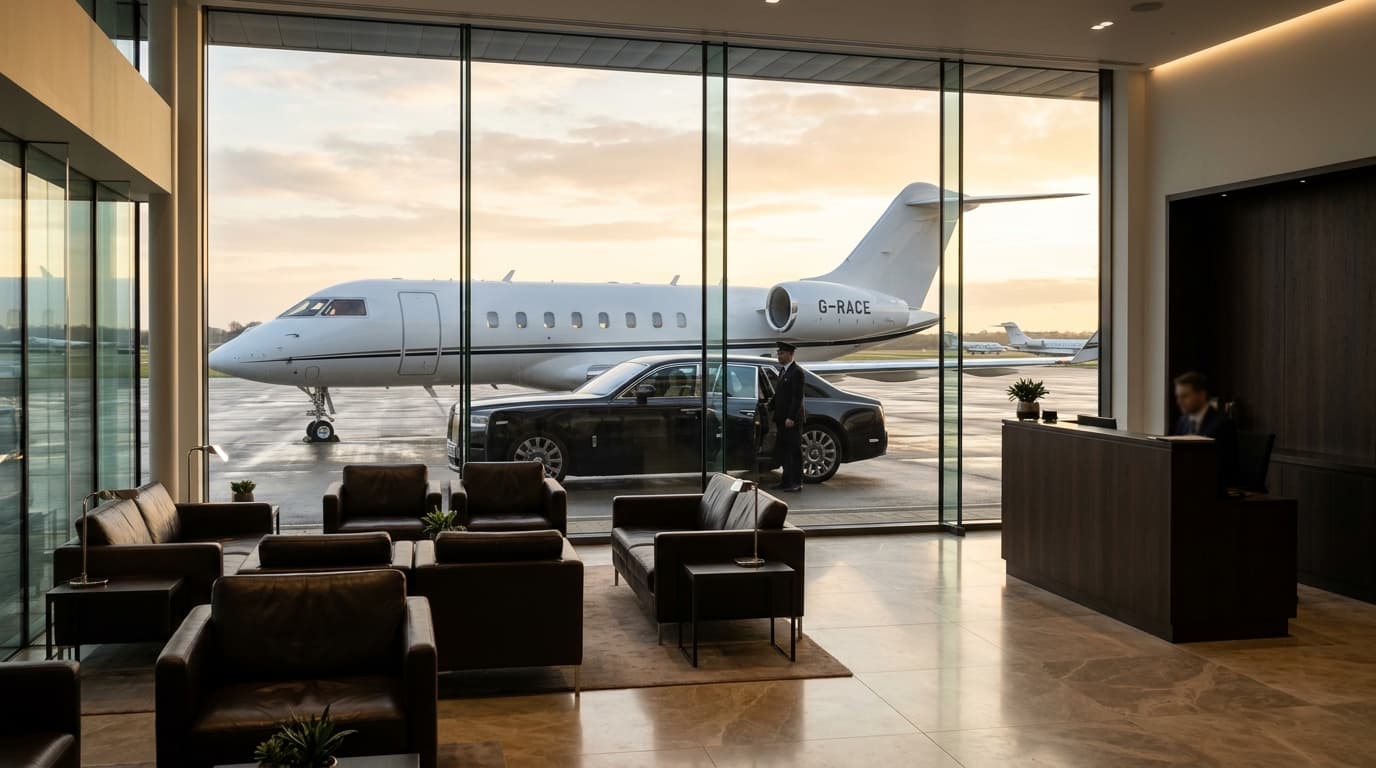
 Farnborough
 Nice
Nice

The Four Models: Dry Lease, Wet Lease, Fractional Ownership, and Jet Cards Defined
Most clients who sign a fractional ownership agreement fly fewer than 150 hours in their first year, yet the entry cost on a one-sixteenth share of a Bombardier Challenger 350 has already committed capital equivalent to 60 to 80 on-demand charter hours. Understanding the full structure of private aviation access starts with separating four distinct arrangements that private jet leasing companies typically offer, each carrying a radically different risk and cost profile.
A dry lease transfers an aircraft to the lessee without crew, maintenance, or insurance. The operator assumes nearly all operational responsibility, which is why dry leases remain the domain of airlines and established corporate flight departments rather than individual high-net-worth travellers. Wet leases include crew, maintenance, and typically insurance, placing them closer to what most clients encounter when dealing with fractional providers or dedicated fleet operators.
Fractional ownership involves purchasing a defined share of a specific aircraft, expressed as a fraction: one-sixteenth (50 hours annually), one-eighth (100 hours), or one-quarter (200 hours). The share grants guaranteed aircraft availability within a fixed notice window and access to the provider's wider fleet when the dedicated aircraft is otherwise committed. Programmes run through providers such as NetJets, Flexjet, and Wheels Up, each covering different aircraft categories and geographies.
Jet cards are prepaid blocks of flight time, sold in units of 25 hours or more. There is no ownership stake: the buyer acquires flight hours at a fixed rate with predictable per-hour costs, but the fine print determines how much of that predictability survives contact with a real trip itinerary.
What Private Jet Leasing Actually Costs (Acquisition, Management Fees, and Hidden Exposure)
The headline acquisition figure issued by private jet leasing companies is almost never the number that matters most. A one-sixteenth share of a Cessna Citation Longitude, covering 50 annual hours on an aircraft with a 3,500 nm range, currently lists in the region of £700,000 to £900,000 depending on aircraft vintage and provider. That share purchase is followed immediately by monthly management fees covering maintenance reserves, storage, insurance, and programme administration, typically running to £9,000 to £14,000 per month on a midsize aircraft.
Occupied hourly rates apply on top of those fees, covering fuel surcharges, crew costs, and landing fees charged per occupied flight hour. For a Citation Longitude, expect £4,000 to £5,500 per hour, bringing the all-in annual cost for a one-sixteenth holder flying their full 50-hour entitlement to somewhere between £360,000 and £490,000 before repositioning charges are counted.
Repositioning fees are where cost comparisons typically collapse. When your assigned aircraft is not parked within a defined proximity of your departure airport, ferry fees apply. An early morning departure from EGSS Stansted to LEIB Ibiza when the aircraft overnighted in Nice means either paying for an empty positioning leg or accepting a fleet substitute. Some programmes cap these fees; many do not.
A useful check is to model the total three-year cost rather than the annual figure. Over three years, a one-sixteenth share in a midsize category aircraft, including acquisition amortisation at typical residual values, management fees, and occupied hourly rates, typically runs to £1.1 million to £1.4 million for a client using their full annual entitlement. That is the figure that should be weighed against equivalent charter costs before any agreement is signed.
The exposure that catches most clients off-guard is depreciation. A fractional share is a real asset on your balance sheet, and it loses value like any aircraft. When you exit the programme or the share matures, the residual value depends on secondary-market conditions for that specific type. An Embraer Phenom 300E share holds value relatively well among light jets; a five-year-old Learjet 75 share is worth materially less than its original purchase price.
Fractional Ownership vs On-Demand Charter: A Side-by-Side Comparison for 50–200 Annual Hours
At 50 annual hours, the arithmetic rarely favours fractional ownership. The total cost of holding a one-sixteenth share, including management fees and occupied hourly rates, produces an effective per-hour cost of £7,000 to £9,500 depending on aircraft category. On-demand charter for equivalent sectors on a comparable aircraft, such as an Embraer Legacy 500 or Hawker 800XP, runs to £4,500 to £6,500 per occupied hour, with no asset risk, no management overhead, and full flexibility on aircraft type per trip.
At 100 annual hours, the analysis sits in genuinely contested territory. A one-eighth share on a Dassault Falcon 2000LXS or Gulfstream G280 produces total annual costs in the £680,000 to £820,000 range, while charter for an equivalent pattern of sectors runs to approximately £600,000 to £750,000 through a well-connected broker. The gap narrows significantly, and factors beyond pure cost, including guaranteed availability during peak periods and a preference for consistent aircraft configuration, can tip the decision either way.
At 200 annual hours, the case for fractional ownership grows more credible. A one-quarter share on a Gulfstream G280 or Dassault Falcon 2000LXS will produce an all-in per-hour figure in the £5,500 to £7,000 range, which begins to approach broker-sourced charter rates on major European routes. Fractional programmes commit to an aircraft within four to eight hours' notice, a guarantee that on-demand charter matches comfortably in off-peak periods but cannot provide universally.
The critical variable in all three scenarios is what happens in low-utilisation years. A fractional holder flying 220 hours in year one and 80 hours in year two still pays management fees through both years. Charter clients pay nothing when they are not flying. For clients whose travel patterns are event-driven rather than regular, that asymmetry compounds across a three-to-five-year programme term and frequently reverses any per-hour saving.
The calculus shifts for consistent ultra-long-range requirements. If your travel routinely involves EGLL London Heathrow to JFK sectors or longer, fractional ownership of a Gulfstream G650ER or Bombardier Global 7500 offers genuine advantages in crew familiarity and scheduling continuity. The Global 7500 covers 7,700 nm with a 6 ft 2 in standing-height cabin; the Gulfstream G650ER and Dassault Falcon 8X are the two direct comparators in the ultra-long-range segment, and for clients flying those sectors ten or more times annually, locking in access has real value beyond the hourly arithmetic.

Jet Cards: The Middle Ground and Where the Fine Print Bites
At 25-hour increments and a typical price of £120,000 to £175,000 on a midsize-category aircraft, card programmes initially appear to offer a sensible bridge between ad-hoc charter and full programme commitment. The appeal is genuine: a defined hourly rate, no ownership stake, and no long-term management liability.
Peak-day surcharges are the most common pressure point. Many cards impose premium rates on defined high-demand dates, including UK bank holidays, school half-terms, and major events such as the Monaco Grand Prix or the Wimbledon fortnight. A card quoted at £5,800 per hour may cost £7,200 per hour on a Friday in late July, a distinction that only becomes apparent when the bill arrives.
Segment minimums create a second distortion. Most cards charge a minimum flight time per leg, typically one or two hours, regardless of the actual sector length. A positioning flight from EGLF Farnborough to EGSS Stansted, which in practice takes 22 minutes, is billed at the one-hour minimum. For clients operating multiple short sectors in a single trip, this erodes the headline rate in ways that do not appear in any marketing document.
Expiry terms add further constraint. Most cards expire after 12 to 18 months with no rollover. A client who purchases 25 hours in January and flies 18 by November forfeits the remainder unless travel resumes promptly. Refunds are rare and typically tied to a cancellation fee that offsets most of the recovered value.
When On-Demand Charter Wins: How to Use a Broker to Your Advantage
For any client flying fewer than 200 hours annually without a consistent requirement for the same aircraft type and crew, on-demand charter arranged through a specialist broker outperforms every fixed-commitment model on pure economics, and the gap widens when travel patterns are irregular. A London-based client flying eight to twelve sectors annually across European routes, including LFPB Le Bourget for Paris, LSGG Geneva for ski season, and LEPA Palma for summer, can access a Cessna Citation CJ4 or Embraer Phenom 300E per sector without committing capital or absorbing management fees in quieter months.
A representative midsize sector, London to Nice aboard a Citation Longitude, runs to approximately £18,000 to £24,000 one-way at current market rates, depending on positioning and timing. Over ten such sectors annually, that totals £180,000 to £240,000 against the £360,000 to £490,000 all-in cost of holding the equivalent fractional share. The broker's fee, where it applies, is embedded in the charter rate rather than charged separately, and a well-managed broker relationship carries no retainer.
Empty-leg access extends the economic advantage further. A client flying London to the French Riviera regularly across the summer, and occasionally returning independently, will find genuine empty-leg opportunities if a broker understands the travel pattern in advance. A Gulfstream G550 repositioning from LFMN Nice back to London can be available for £8,000 to £12,000, a fraction of the full charter rate for an equivalent sector, and these opportunities multiply across popular seasonal routes.
When evaluating private jet leasing companies and their respective programme structures, the correct question is not which provider offers the most competitive per-hour rate. The question is what the total committed outlay looks like over three years, accounting for management fees, depreciation, and the realistic probability of underutilisation. If that figure exceeds the projected cost of equivalent charter by more than 15 per cent, the case for commitment weakens substantially.
The threshold is unambiguous: clients flying fewer than 200 hours annually, without a stable pattern of identical aircraft requirements, are consistently better served by on-demand charter than by any of the ownership or card products that private jet leasing companies offer. Above 200 hours, with regular long-haul demand and a clear preference for crew continuity, fractional ownership of an appropriately specified aircraft merits serious evaluation. Below that line, the economics do not support a signature.