 Farnborough
 Nice
Nice
Private Jet Hire, Charter, and Rental: What the Terms Actually Mean
Every broker in Europe receives enquiries using "hire", "rental", and "charter" interchangeably, and the aviation industry has never settled on a standard; which means the first decision most first-time clients agonise over before making contact is, strictly speaking, irrelevant.
Charter is the term operators and brokers use internally. Hire and rental migrated into common usage from adjacent luxury markets (car hire, yacht charter) and carry identical meaning in practice. All three phrases describe the same transaction: sole-use access to a private aircraft for a specific routing, departing on your schedule.
Understanding the broader access models matters more than the terminology. On-demand charter means booking a single trip with no prior commitment; you pay for the flight, the flight happens, and the arrangement closes. Fractional ownership involves purchasing a share in a specific aircraft type and committing to a minimum number of flying hours annually. Jet card programmes offer pre-purchased blocks of hours against a guaranteed fleet category. For most first-time clients, on-demand private jet hire through a broker is the natural starting point: no capital tied up, no programme commitments, and full flexibility to choose a different aircraft type for every trip.
When you book through a broker, the broker sources the aircraft from an operator who holds a valid air operator certificate (AOC). The operator provides the aircraft, crew, and technical oversight. The broker manages the sourcing, pricing, and client experience. A broker with access to a large European fleet consistently secures better availability and pricing than approaching a single operator directly, because aircraft can be drawn from a broader pool.
How the Booking Process Works: From First Enquiry to Wheels Up
A first enquiry for private jet hire submitted at 9am can result in a confirmed departure before noon. The sequence is shorter than most first-time clients expect, and it runs identically whether you are departing from EGLF Farnborough, EGSS Stansted, or a smaller general aviation airfield.
The initial conversation covers four points: departure airport, destination, date and preferred departure time, and passenger numbers. No passport details, no full itinerary, and no prior account are required at this stage. A broker typically returns three to five aircraft options with all-in pricing within minutes of the first contact.
Selecting an aircraft triggers a standard charter agreement, which sets out the routing, aircraft registration, timing, and total cost. For international sectors, passenger names and passport details are submitted to handling agents ahead of departure. Payment is due before wheels-up; the standard terms for planned trips are bank transfer five to ten business days in advance.
Charter agreements allow for reasonable adjustments before departure. Most brokers accommodate timing changes on the morning of travel without difficulty. Significant routing changes after aircraft confirmation may involve repricing, particularly if the original aircraft cannot cover the revised sector without repositioning.
Once confirmed, the broker coordinates everything downstream: FBO handling at both ends, catering to your specification, and ground transport if required. By the time you arrive at the departure terminal, all logistics are complete.
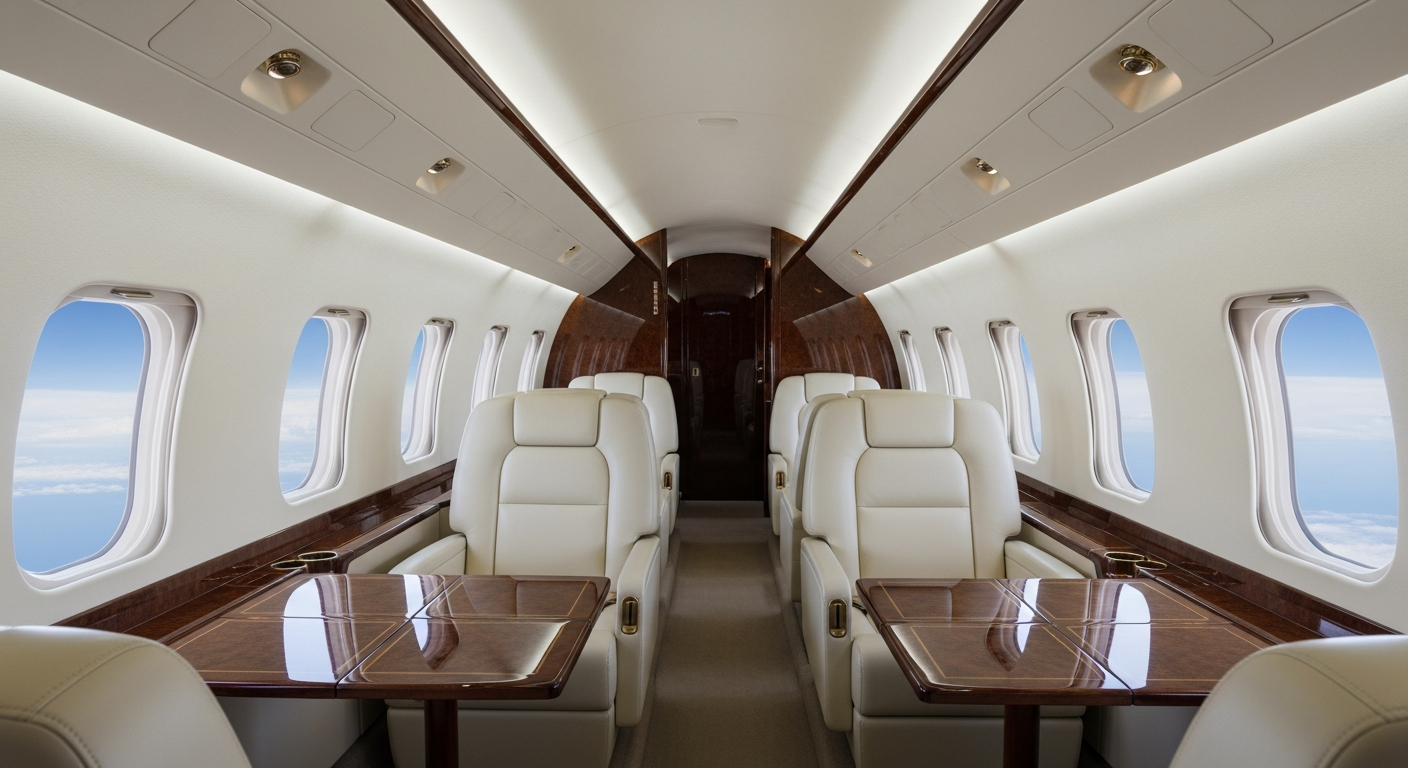
Choosing the Right Aircraft: What the Size Categories Mean in Practice
Passenger count and sector length, not prestige, should drive every aircraft selection decision.
Very light jets seat three to four passengers and are suited to shorter European sectors below 1,000 nautical miles. The Embraer Phenom 100EV has a cabin width of 4 ft 10 in and a standing height of 4 ft 7 in. Practical for two passengers on a quick hop to a nearby destination; less so for a four-person group on a two-hour sector where luggage is a consideration.
Light jets cover the majority of popular European routes. The Embraer Phenom 300E has a cabin 5 ft 1 in wide, seats up to six, and has a maximum range of 2,010 nautical miles. London to Ibiza (LEIB), Geneva (LSGG), or Dubrovnik (LDDU) all sit comfortably within its operating envelope. For small groups on sub-two-hour sectors, this category typically offers the sharpest value.
Midsize jets add cabin height, luggage capacity, and meaningful range. The Cessna Citation Longitude has a cabin 6 ft 2 in wide and 5 ft 11 in tall, seats up to twelve, and offers a range of 3,500 nautical miles. For a group of four to six flying to the Eastern Mediterranean, the Gulf, or the East Coast of the United States, the Longitude removes the range compromise entirely.
Large-cabin jets such as the Bombardier Challenger 650 and the Dassault Falcon 7X carry eight to fourteen passengers in stand-up comfort, with genuine intercontinental range. The Challenger 650 has a cabin height of 6 ft 1 in and a range of approximately 4,000 nautical miles.
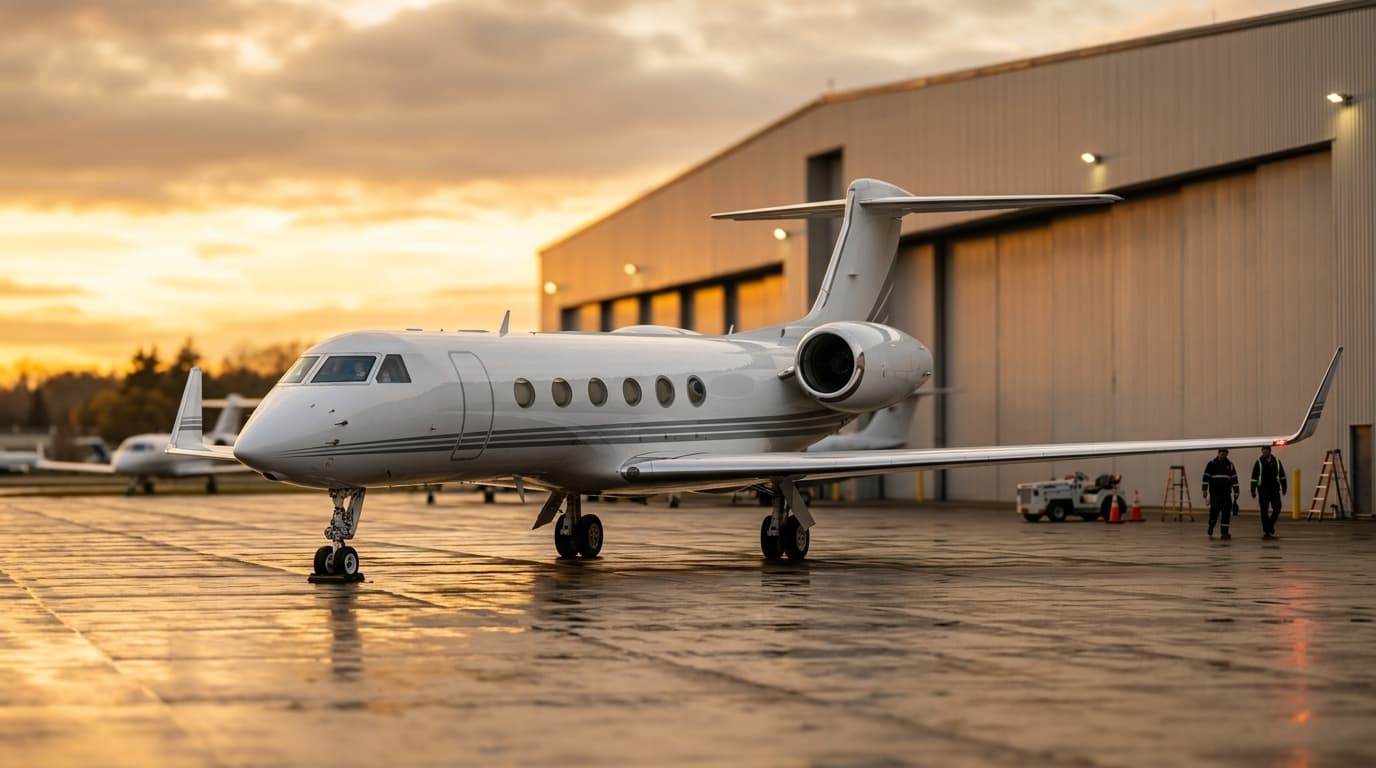
Ultra-long-range aircraft define the top of the market. The Gulfstream G650ER has a range of 7,500 nautical miles and a cabin length of 46 ft 1 in. The Bombardier Global 7500 reaches 7,700 nautical miles with four distinct living zones. The Dassault Falcon 8X covers 6,450 nautical miles with one of the widest cabin cross-sections in its class.
London to Singapore (WSSS) non-stop is within reach of all three. In this segment, the Gulfstream G700 and the Dassault Falcon 10X are the two direct challengers: the G700 delivers a substantially wider and taller cabin than the G650ER, while the Falcon 10X brings Dassault's largest fuselage cross-section to a quoted range of 7,500 nautical miles.

What Does Private Jet Hire Cost? A Realistic Breakdown
Pricing reflects a set of real variables: aircraft type, routing, date, and the distance the aircraft needs to travel to reach your departure airport. Understanding these components removes most of the uncertainty.
The base charter fee covers the flying hours on the agreed aircraft for your sector. Added to this are landing fees, FBO handling charges at both airports, and sometimes a repositioning fee when the aircraft is based at a distance from your chosen departure point. Catering and ground transport are typically itemised separately.
For a concrete reference point: an EGLF Farnborough to LEIB Ibiza sector in a Phenom 300E typically costs £14,000–£18,000 one-way in peak summer, depending on aircraft positioning and the specific date. The same routing in a Cessna Citation Longitude sits closer to £22,000–£28,000. For a group of six on the light jet option, the cost divides six ways; on a midsize aircraft with a larger cabin, the per-head figure on a group trip can narrow considerably.
Peak summer pricing for Mediterranean sectors typically runs 15–25% above shoulder-season rates, reflecting higher demand and positioning costs across a busy European fleet. The period from late June through early September, and the Christmas ski window, consistently see the tightest aircraft availability. For popular routes during these periods, booking three to four weeks in advance is the sensible standard.
Empty legs offer the best available discount in the market. When an operator repositions an aircraft without a paying passenger, that flight is released at 50–75% below the standard charter rate. Routing and timing are fixed and cannot be changed after booking, but for itineraries with flexibility on both sides, empty legs are worth tracking.
VAT applies at 20% on domestic UK private jet hire. Most international departures from the UK are zero-rated, though destination-country taxes vary. A reputable broker will itemise the all-in figure, including applicable taxes, before any agreement is signed.
What to Expect on the Day: Private Terminals, FBOs, and Departure
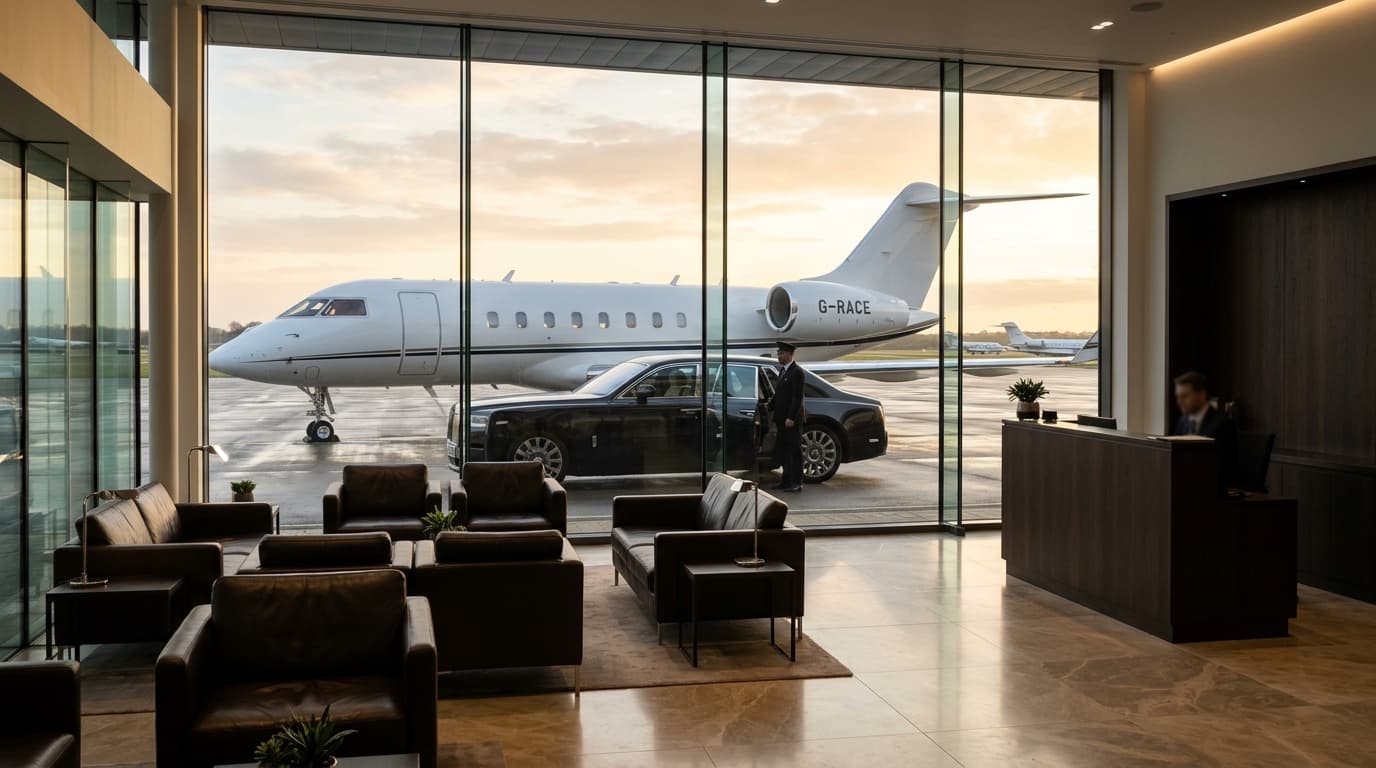
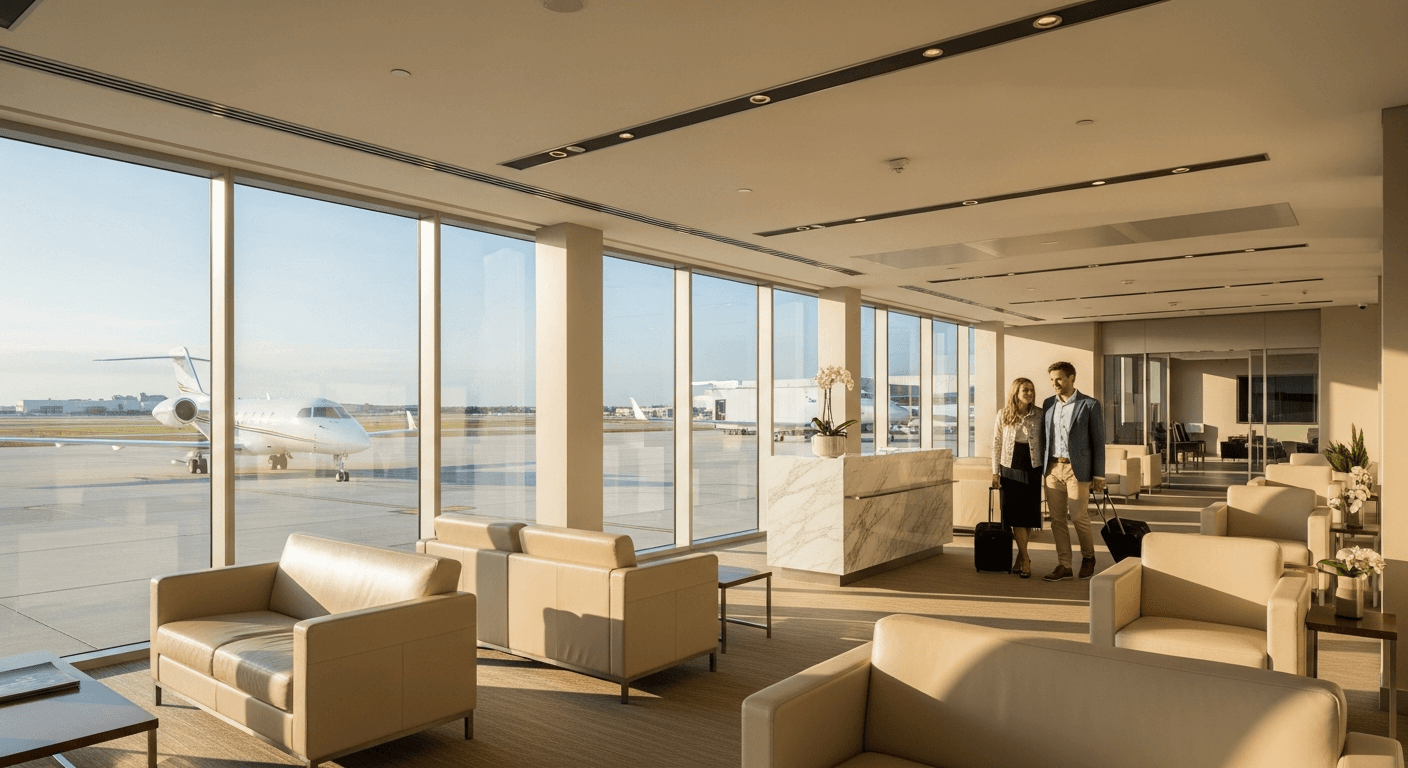
The departure process at a private FBO is compressed to a matter of minutes. At EGLF Farnborough, EGSS Stansted Business Aviation Centre, or EGTK London Oxford, you drive directly to the terminal, check in at a private reception desk, and move through security screening without queuing.
Most FBOs request arrival 20 to 30 minutes before departure. Security takes under five minutes; bags are taken directly to the aircraft. You board when ready, and the crew briefs you privately. Catering specified at booking is already in place.
International arrivals on a private flight typically clear customs and immigration at the destination FBO, in a private hall adjacent to the aircraft stand, with processing completed in the time it takes for bags to be offloaded. The efficiency at both ends of the journey is part of what makes private aviation most effective for time-sensitive travel.
Ground transport is pre-arranged by the handling agent at your destination. In most cases, the gap between the aircraft door opening and a car moving is under ten minutes. On arrival at a smaller airfield with minimal traffic, this process is faster still.
The airports outside the reach of fixed-schedule operations represent one of the clearest practical advantages of private jet hire. Courchevel (LFLJ) has a 537-metre runway at 6,588 feet altitude; landing there requires specific aircraft type approval and crew certification for short-field and high-altitude operations. Samedan (LSZS) near St Moritz sits at 5,600 feet and regularly closes to unprepared operators in poor winter visibility. For ski access or remote villa arrivals, the ability to land at a field that general charter aircraft can reach is often the single deciding factor in how a private aviation booking is justified.